

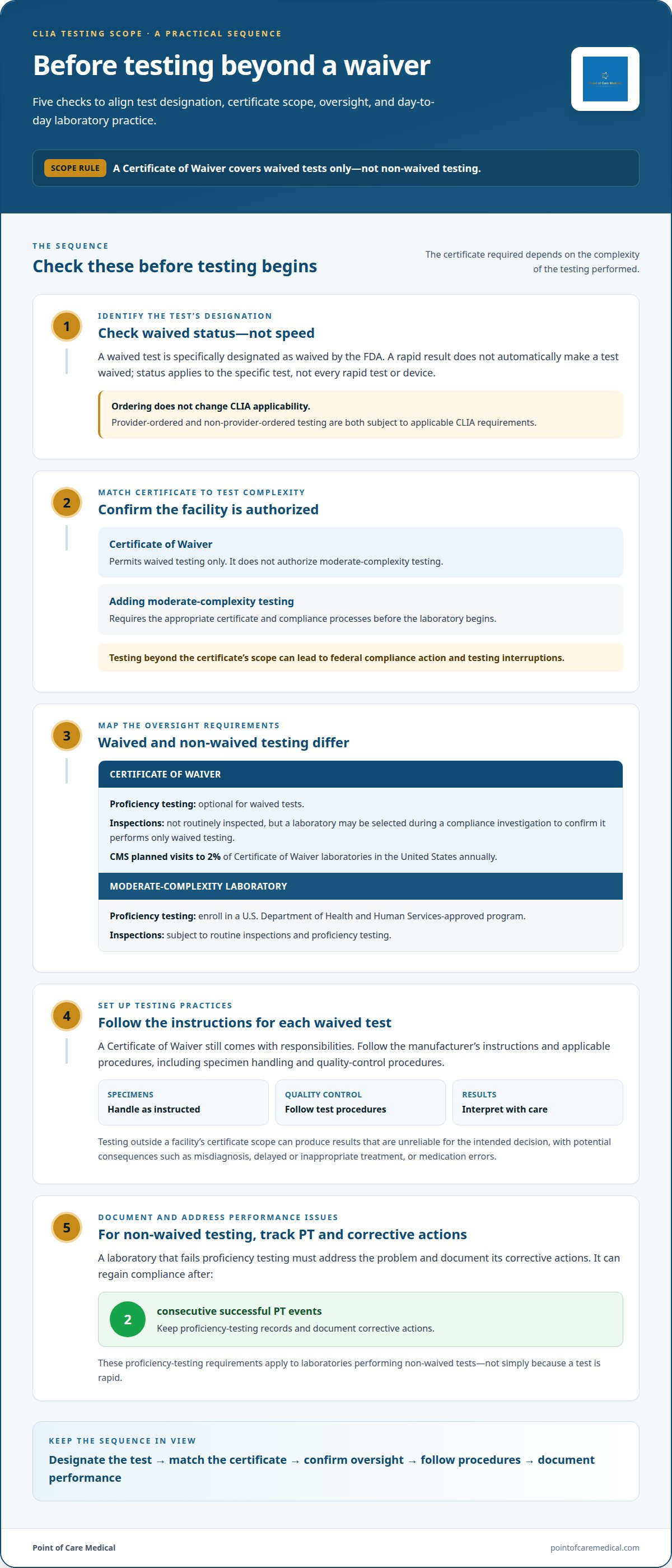
A CLIA Certificate of Waiver covers only tests designated as waived. It does not authorize a facility to perform non-waived testing. The consequences of using non-CLIA waived tests under the wrong certificate can include compliance action, testing interruptions, and risks to patient care. The required certificate depends on the test’s complexity.
A rapid test is not automatically waived: speed alone does not determine its CLIA status. Understanding the consequences of using non-CLIA waived tests starts with identifying the test’s designation and matching it to the facility’s certificate. This guide explains when testing requires a different certificate and how certificate scope affects laboratory operations.
You’ll also learn what penalties may apply and which personnel and training requirements matter when staff perform testing. Understanding the consequences of using non-CLIA waived tests can help healthcare and screening facilities align test selection, certification, and procedures before testing begins.
Key Takeaways
- Determine a test’s CLIA status by its waived designation, not by how quickly it produces a result.
- Provider-ordered and non-provider-ordered testing are both subject to applicable CLIA requirements.
- Match the laboratory’s certificate to the complexity of the testing it performs.
- Support reliable waived testing with staff training, documented competency, and procedures aligned with manufacturer instructions.
- Understand how noncompliance can affect patient care, testing operations, and a laboratory’s CLIA certificate.
What are CLIA waived tests?
A CLIA-waived test is a simple laboratory test that the U.S. Food and Drug Administration has designated as waived. The Centers for Medicare & Medicaid Services regulates human laboratory testing through the Clinical Laboratory Improvement Amendments (CLIA). For covered testing, a facility needs the appropriate CLIA certificate. Waived status applies to the specific test, not to every rapid test or device used by a facility.
Waived tests use methods considered simple, with a low risk of erroneous results when performed correctly. Examples include blood glucose, urine dipstick, rapid strep, and urine pregnancy tests. More than 1,400 test systems have waived status. A facility with a Certificate of Waiver must limit testing to waived tests and follow each manufacturer’s instructions, including specimen handling and quality-control procedures.
Can test results from a non-CLIA-certified laboratory be used for diagnosis or treatment? Results from covered testing at a non-CLIA-certified facility do not replace testing performed under the required certification. A clinician may need a compliant laboratory test to support a diagnosis or treatment decision.
A rapid result can guide an initial clinical decision, but it may not settle the question. Depending on the test and clinical circumstances, confirmatory laboratory testing may be necessary. For example, a preliminary result may prompt follow-up testing before a clinician decides on treatment. Rapid testing does not eliminate the role of laboratory services or make every result definitive.
How can using non-waived tests affect patient safety and clinical decisions? Testing outside a facility’s certificate scope can produce results that are unreliable for the intended decision. Errors may contribute to misdiagnosis, delayed or inappropriate treatment, or medication errors. These risks make test designation, staff procedures, and result interpretation important to patient care.
Proficiency testing (PT) is optional for waived tests. Laboratories performing non-waived tests must enroll in a U.S. Department of Health and Human Services-approved PT program. If a laboratory fails PT, it must address the problem; it can regain compliance after two consecutive successful PT events. PT participation and corrective actions apply to laboratories subject to those requirements, not simply because a test is rapid.
For a waived-test device recall or field correction, the facility should follow the manufacturer’s notice and instructions for affected products. Identify the affected device or lot, separate it from routine use as directed, and document the actions taken. These steps help prevent use of a device covered by a correction and preserve a clear record for patient care and laboratory procedures.
Applicability to provider-ordered and non-provider-ordered testing
CLIA requirements depend on the laboratory testing performed, not on who ordered it. A physician’s order does not exempt a test from the Clinical Laboratory Improvement Amendments. Testing not ordered by a provider also falls under CLIA when it meets the definition of covered laboratory testing on human specimens. The setting and purpose matter, not whether a clinician requested the test.
What are the consequences of performing non-CLIA-waived tests without the required CLIA certificate? A facility that tests beyond its certificate’s scope risks federal compliance action and testing interruptions. A Certificate of Waiver authorizes waived testing only. Adding moderate-complexity testing requires the appropriate certificate and compliance processes before the laboratory begins.
Adding testing changes the laboratory’s oversight obligations. Moderate-complexity testing is subject to routine inspections and proficiency testing. Non-waived laboratories must enroll in a proficiency-testing program approved by the U.S. Department of Health and Human Services. PT evaluates performance against program criteria and creates records to support review of results and corrective actions.
Proficiency testing is optional for waived tests. That does not make other quality practices optional: facilities performing waived tests must still follow manufacturer instructions and applicable procedures. An existing waiver does not authorize a facility to add non-waived testing. It needs a certificate appropriate to the new testing and must meet the associated requirements.
Inspection patterns also differ by certificate type. Laboratories with a Certificate of Waiver are not routinely inspected, but may be selected during a compliance investigation to confirm that they perform only waived testing. CMS planned visits to 2% of Certificate of Waiver laboratories in the United States annually. Moderate-complexity laboratories face routine inspections and proficiency testing, so expansion affects day-to-day oversight as well as certification.
Inspection practices can vary, so laboratories should keep proficiency-testing records and document corrective actions. For a clinical laboratory, these records help show how it handled testing-performance issues. A failed event calls for corrective action and careful documentation; repeated failures can affect whether testing continues. The certificate type therefore shapes the laboratory’s PT duties, inspection exposure, and operational planning.
Apply the same scope review when testing moves into an office or screening workflow. Home tests performed in an office practice fall within CLIA’s scope, even if the device is intended for home use. For teams assessing specimen formats in screening workflows, explore oral fluid testing options as one product category.
CLIA waiver and moderate-complexity testing requirements
State requirements can add to federal CLIA rules; some state agencies regulate waived testing directly and require device listings. The Clinical Laboratory Improvement Amendments of 1988 require covered facilities to be certified by the Secretary of the Department of Health and Human Services, according to U.S. Congress.
Requirements for Non-Waived Testing
Non-waived testing requires a certificate suited to its complexity, not a Certificate of Waiver. CLIA classifies tests as waived, moderate complexity, or high complexity. A laboratory performing moderate-complexity testing may need certification beyond a waiver. The right certificate matters because a waiver does not authorize testing outside its waived scope.
For an application, a facility seeking a Certificate of Waiver submits CMS-116 to CMS or its state health department. A waiver permits only the waived tests designated in the application. It remains valid for two years, according to the Centers for Medicare & Medicaid Services. A laboratory expanding its test menu must account for the new test’s complexity before performing it.
Proficiency Testing and CLIA Certification
Proficiency testing assesses laboratory performance by comparing results with program criteria. Laboratories performing non-waived tests must enroll in a U.S. Department of Health and Human Services-approved program. Moderate- or high-complexity testing requires participation for each CLIA certificate held, with one PT program per location, excluding Certificates of Waiver.
Accreditation also affects which requirements apply. Proficiency-testing requirements can vary depending on how a laboratory is overseen and accredited. Cytology testing has additional requirements: under 42 CFR § 493.945, laboratories performing cytology testing have unique proficiency-testing requirements, according to the U.S. Department of Health and Human Services.
Certificate choice also determines the required quality framework. A Certificate of Compliance may cover waived, provider-performed microscopy, and moderate- or high-complexity tests when the laboratory meets CLIA quality standards. A Certificate of Accreditation can cover those categories after review and designation by an applicable partner organization. The testing performed, its complexity, and the certificate held must align.
Before adding a test, identify its CLIA category and the certificate required for that scope. Then complete the applicable application and prepare for its assessment and quality obligations. Some state agencies may also require specific devices to appear on a waived-test application, so state rules can affect device documentation as well as federal certification.
Personnel qualifications and training
Reliable testing depends on staff who understand each device, specimen, and procedure they use. For waived testing, hospital staff should receive training for every test they are authorized to perform, and the training should be documented. A general orientation to point-of-care work does not cover device-specific steps. Staff need to know how to use each test and follow the manufacturer’s instructions for quality controls.
Build training around the actual device and its operating instructions. New clinical staff and providers should receive orientation for each waived-test device. Include a return demonstration so the staff member can show the procedure and quality-control steps. A supervisor can use the demonstration to spot missed steps, such as incorrect specimen handling or failure to complete a required control.
Include quality-control practice in training rather than treating it as a separate topic. Medical practices should perform a quality-control test for each new user on each device. This gives the practice a practical way to assess device-specific competence before a staff member begins testing patients independently. Keep the results with the training record, alongside the device and test covered.
- Explain the procedure: Review the manufacturer’s instructions, specimen requirements, and result interpretation for the specific test.
- Demonstrate the workflow: Show the staff member how to prepare the device, run controls, perform the test, and record results.
- Observe a return demonstration: Watch the staff member complete the process, then document training and any follow-up instruction.
- Assess ongoing competency: Use a defined method and retain evidence of the assessment in the facility’s records.
For hospitals, The Joint Commission requires competency assessment and documentation at orientation and defined intervals, at least annually thereafter. It also recognizes multiple assessment methods. Hospitals may observe routine work, review quality-control performance, use blind specimens, or administer written testing. Using more than one method can show whether staff follow both procedural steps and the facility’s quality expectations.
Competency records support oversight by showing who was trained, which test they may perform, and how their performance was assessed. A training file should link the staff member, named device, and relevant procedure. If a manufacturer changes instructions or a facility introduces a different device, update the applicable training materials and assess whether staff need further instruction.
CMS oversight does not replace local training and documentation. A facility’s written procedures should align with manufacturer instructions, and staff practice should follow those procedures. Clear records help a laboratory identify training gaps, respond to recurring control problems, and maintain consistent testing practices across shifts and users.
CLIA inspection penalties
CLIA enforcement can affect a laboratory’s testing authority, reimbursement, and patient-care operations. Consequences depend on the violation, its seriousness, and whether testing could put patients at risk. A finding involving waived-test procedures differs from a violation that creates immediate jeopardy, so the response should match the specific compliance issue.
In the United States, according to the Centers for Medicare & Medicaid Services, lower-level or nonimmediate-jeopardy violations of CLIA-waived test standards can result in penalties of $50 to $3,000 per day or violation. More serious violations that could harm patients can bring higher fines, exclusion from federal programs, and possible imprisonment. These are distinct enforcement outcomes, not automatic penalties for every testing error.
Inspections may be random or prompted by patient or employee complaints. A Certificate of Waiver laboratory is not routinely inspected, but a compliance investigation may examine whether it performs only waived tests. Inspectors may also assess whether testing follows manufacturer instructions and whether the facility maintains appropriate procedures. A device used outside the certificate’s scope can raise a different compliance concern from a documentation gap.
Keep a clear record of the testing performed and corrective steps taken. For example, if a control result identifies a problem, document the issue, the response, and the decision about affected patient specimens. If a laboratory discovers it performed a test beyond its certificate, it should address the scope problem and stop performing that test under an authorization that does not cover it.
Proficiency-testing violations can have separate consequences. A laboratory that violates PT referral rules may have its CLIA certificate revoked. Referral violations can also restrict an organization’s ability to conduct testing, including limits on a laboratory director’s or owner’s laboratory operations. Repeated PT failures or referral violations can halt testing and suspend reimbursements, disrupting patient care and business operations.
When a finding involves possible patient harm, review whether results affected diagnosis or treatment and determine what corrective action is needed. Improper quality procedures can produce false point-of-care results, potentially leading to erroneous medical decisions. The facility’s records should link the affected test and specimens to the response, helping show how the issue was contained and addressed.
Use the inspection or compliance review to identify the specific gap, assign corrective actions, and document completion. If the review concerns waived testing, compare the facility’s procedures with the manufacturer’s instructions and confirm that testing stayed within the certificate’s scope. For facilities reviewing point-of-care supply needs, explore rapid testing supplies for their screening workflows.
Point of Care Medical: Oral Fluid tests
Point of Care Medical supplies Oral Fluid tests for healthcare and screening facilities sourcing drug-screening products. Once your testing workflow and applicable requirements are established, selecting supplies that fit the intended screening program is a practical next step. The catalog also includes the Rapid Test Cup "RTC" + Fentanyl, GenBody COVID-19 Rapid Antigen Test, and ViraDx™ SARS-CoV-2/Flu A+B Rapid Antigen Test.
Choose the product category that matches your facility’s screening or respiratory-testing needs, and keep test use aligned with the applicable certification and manufacturer instructions. For questions about these testing supplies, contact Point of Care Medical.
Plan Your Next Testing Decision
Make test selection part of operational planning, not a last-minute purchasing decision. Before adding a test to a workflow, align its intended use with the laboratory’s certification, staffing, and procedures. This helps decision-makers consider the consequences of using non-CLIA waived tests before a new process affects routine operations.
Keep procurement conversations focused on the testing program’s actual needs. Point of Care Medical supplies diagnostic testing products for healthcare and screening facilities, including respiratory, infectious-disease, and toxicology options. A clear understanding of your workflow can help focus the discussion on relevant product categories.
For a practical next step, contact Point of Care Medical to discuss testing supplies for your facility. With the right operational planning, your team can move forward with greater clarity and confidence.
Frequently Asked Questions
What is Clinical Laboratory Improvement Amendments (CLIA)?
CLIA is the federal framework governing most laboratory testing on human specimens in the United States. It sets certification requirements according to the testing a laboratory performs. For example, a clinic testing patient specimens for diagnosis needs certification appropriate to its test menu. The laboratory’s purpose and test complexity shape which requirements apply, so a rapid format alone does not establish a test’s CLIA category.
Why Does It Matter?
CLIA matters because test results can influence diagnosis, treatment, and other patient-care decisions. A clinic that performs tests beyond its certificate’s scope risks compliance action and testing interruptions. For example, adding a moderate-complexity assay to a waived-only workflow changes the facility’s certification and oversight needs. Aligning the test menu, certificate, procedures, and staff training helps keep clinical operations organized.
What CLIA certificate is required to perform moderate- or high-complexity laboratory tests?
A laboratory performing moderate- or high-complexity testing needs a Certificate of Compliance or Certificate of Accreditation, with the certificate and testing scope aligned. These certificates can cover waived and other testing categories when the laboratory meets relevant CLIA quality standards. This distinction matters when a clinic plans to add a test: its existing Certificate of Waiver does not authorize moderate- or high-complexity testing.
What are the civil and criminal penalties for violating CLIA requirements?
Penalties depend on the violation and its potential impact. According to the Centers for Medicare & Medicaid Services, lower-level or nonimmediate-jeopardy violations of waived-test standards can bring penalties of $50 to $3,000 per day or violation. More serious violations that could harm patients may lead to higher fines, exclusion from federal programs, or imprisonment. Proficiency-testing referral violations can also result in certificate revocation.
What are the CLIA requirements for personnel, quality control, proficiency testing, and inspections for non-waived tests?
Non-waived laboratories must meet personnel and quality requirements suited to their testing, follow applicable procedures, and participate in an approved proficiency-testing program. For example, a laboratory adding a non-waived assay needs records showing staff training, quality-control activity, and PT performance. Inspection requirements depend on the certificate and oversight pathway. Accredited laboratories follow their accrediting organization’s PT requirements, while CMS-inspected laboratories follow applicable CMS requirements.
How do CLIA-waived tests differ from moderate- and high-complexity tests?
CLIA-waived tests use methods considered simple, with a low risk of erroneous results when performed correctly. Moderate- and high-complexity tests require a certificate and quality framework suited to their assigned complexity. A rapid result does not make a test waived; the test system’s designation determines its category. For instance, a facility must use the appropriate certificate when its test menu includes non-waived assays.
Can a physician office or clinic perform non-waived testing, and how does it obtain CLIA certification?
Yes. A physician office or clinic can perform non-waived testing after obtaining the CLIA certificate appropriate to its test complexity and meeting the related requirements. The application route depends on the certificate sought; a Certificate of Waiver application uses CMS-116 and is submitted to CMS or the state health department. Clinics adding non-waived testing should account for the required quality systems, personnel, and proficiency testing before testing begins.


