

A faster test does not automatically mean a faster emergency department disposition. There is no single fixed time to disposition decision with POC testing: the interval runs from the earlier of registration or triage to the disposition time determined by the main service provider. Point-of-care testing can bring selected results closer to the patient, but it cannot resolve delays caused by bed availability, imaging, staffing, consultations, or admission procedures.
Quicker results can help clinicians make decisions sooner, but the effect on patient flow depends on where testing fits into care and whether a result is needed before disposition. A rapid result may reduce one wait without changing the overall time if another operational step remains the bottleneck.
This article explains how emergency department flow and test turnaround times relate to disposition decisions. You’ll learn how the interval is measured, where point-of-care testing may help, and which workflow factors can limit its impact.
Key Takeaways
- Separate preanalytic, analytic, and postanalytic delays to identify where testing time accumulates and where workflow changes may help.
- A rapid POC result can shorten the testing interval, but it won’t resolve delays caused by imaging, bed availability, consultation, or admission processes.
- Interpret ED wait-time results in context: the measure tracks a visit from registration or triage to the disposition decision.
- Assess POC testing by more than turnaround time. Result-to-decision time, repeat testing, operator error, and cost per reportable result also inform performance.
- According to the U.S. Food and Drug Administration, a score of 12 or less under the test-complexity scoring system described yields a moderate-complexity designation.
Emergency department patient flow and operational bottlenecks
Emergency department flow depends on a sequence of clinical and operational decisions. A patient moves from registration or triage to assessment, testing when needed, result review, and a disposition decision. Point-of-care testing (POCT) can shorten the wait for selected results, but it affects only steps that depend on those results.
The key question is whether a test result is delaying the next care decision. A rapid result may help when a clinician is waiting to decide on treatment, discharge, or further evaluation. It will not free a treatment space, complete imaging, provide a specialist consultation, or move an admitted patient through the admission process. Those constraints can remain the main bottleneck even after testing becomes faster.
Emergency department studies show that the effect depends on the test and workflow. After a hospital introduced point-of-care whole-blood D-dimer testing, mean and median emergency department length of stay and hospital admissions decreased. In contrast, a study of a five-test electrolyte point-of-care panel found no impact on emergency department length of stay. The practical distinction is clear: a faster result matters most when it changes a decision or removes a wait in the patient’s care path.
Department leaders can assess the entire care path rather than relying on a single turnaround figure. Track specimen-to-result time alongside result-to-decision time and emergency length of stay. Also review repeat testing, operator error, central laboratory workload, POCT use, and cost per reportable result. If the result arrives quickly but the decision comes much later, the delay may lie in result communication, clinician availability, or another department step.
Accuracy and quality control are essential to reliable patient care. ASCLS states that CLIA ’88 regulations apply to point-of-care testing programs regardless of location, and that qualified, trained personnel should perform testing. Under the U.S. Food and Drug Administration’s test-complexity scoring system, a score of 12 or less yields a moderate-complexity designation.
POCT also sits within laboratory oversight requirements. Under CLIA, waived-test sites must notify their State Agency of changes in ownership, name, address, or Laboratory Director within 30 days, according to the Centers for Medicare & Medicaid Services. Operational planning should account for the test’s designated complexity and the people who perform it, alongside workflow and result-handling practices.
For patient outcomes, the useful measure is not simply whether a test is fast. It is whether the result reaches the right decision point in time to affect care. This helps a department distinguish testing delays from constraints such as imaging, available beds, physician coverage, consultation, and admission procedures.
Preanalytic, analytic, and postanalytic turnaround times
A laboratory test’s total turnaround time includes work before analysis, the analysis itself, and result delivery. Separating these stages helps a hospital identify where the clinical workflow is adding delay.
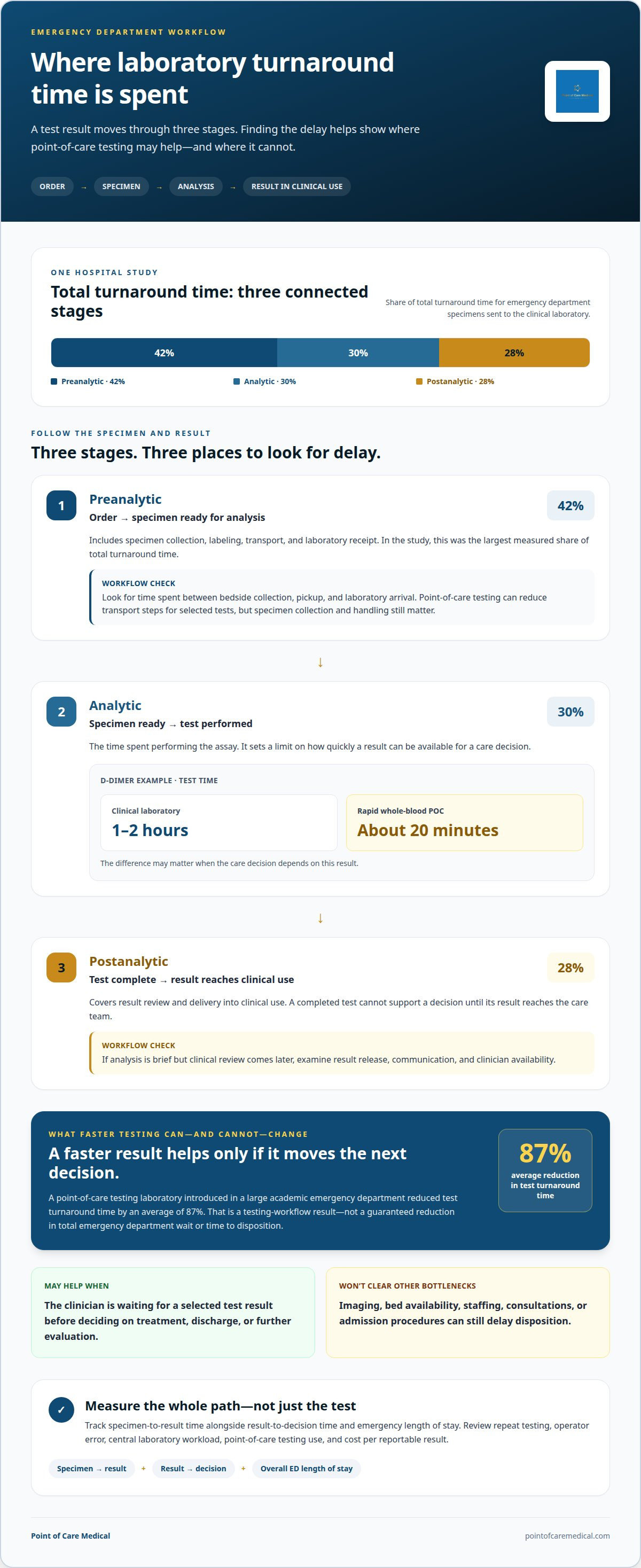
Preanalytic time starts with the test order and covers the steps that prepare a specimen for analysis. These can include collection, labeling, transport, and laboratory receipt. For an emergency department specimen sent to the clinical laboratory, preanalytic work accounted for 42% of total turnaround time in one hospital study. That share makes collection and transport important areas to monitor.
Consider a specimen collected at the bedside that then waits for pickup before reaching the laboratory. The assay cannot begin until the sample arrives and is prepared. A point-of-care workflow brings a selected test closer to patient care and can reduce transport steps. It does not eliminate the need for appropriate specimen collection or handling. Each workflow should match the test and specimen requirements.
Analytic Turnaround Time
Analytic turnaround time is the period spent performing the test after the specimen is ready for analysis. It matters because assay duration sets a limit on how quickly a result can become available. A D-dimer performed in the clinical laboratory may take 1-2 hours, while a rapid whole-blood point-of-care D-dimer takes about 20 minutes. The difference can matter when a care decision depends on that result.
Postanalytic Turnaround Time
Postanalytic turnaround time covers the steps after analysis, including result review and delivery into clinical use. It matters because a completed laboratory test cannot support a decision until its result reaches the care team. In the hospital study, postanalytic work accounted for 28% of total turnaround time. A result awaiting release, communication, or review can therefore remain a workflow delay.
In the same hospital study, analytic time accounted for 30% of total turnaround time for emergency department specimens sent to the clinical laboratory. Together, the measured shares show that analysis is only one part of the interval. A point-of-care testing laboratory introduced in a large academic emergency department reduced test turnaround time by an average of 87%. That result illustrates a change in testing workflow, not a guaranteed reduction in every department’s total wait.
Monitor each stage separately: specimen collection to laboratory receipt, time in analysis, and result availability to clinical review. Compare those intervals with the full test turnaround time. If analysis is brief but the result reaches the care team later, focus on postanalytic steps. If transport consumes substantial time, examine specimen movement. This breakdown helps departments target the relevant process instead of changing a stage that is not driving delay. Teams assessing rapid testing workflows can review point-of-care testing resources.
Factors influencing ED wait-time results
Emergency department wait-time results reflect more than the speed of a laboratory test. Patient acuity, the number of samples, staffing, and the sequence of medical decisions can all shape the interval. To interpret a change after POCT implementation, compare similar patient groups and examine which steps changed. Otherwise, a shift in case mix may look like a testing effect.
Testing demand adds another layer. In one emergency department study, 76% of patients received laboratory testing, with an average of 7.7 tests per patient. Complete blood counts were performed for 66.9% of patients, and basic metabolic panels for 65.4%. These figures show why laboratory workload and test ordering patterns matter when evaluating turnaround. A department should consider whether a change affects the test pathway used by its patients.
Clinical timing also influences the result. In a prospective case-controlled study, 52 adult patients receiving POCT were matched with 52 controls. Mean time to physician assessment was 3.3 hours for the POCT group and 3.1 hours for controls. The difference was not statistically significant (p=0.84). The confidence intervals were 2.2 to 4.4 hours and 2.2 to 4.5 hours, respectively. A faster result alone does not establish earlier assessment.
Patient flow changes can affect the same measure independently. A meta-analysis of advanced emergency department triage protocols found a 36-minute reduction in patient length of stay, with low certainty of evidence. That finding illustrates why leaders should track operational changes alongside testing changes. If triage procedures, staffing, or treatment-space availability shift during implementation, those factors can influence outcomes and make attribution difficult.
Use a consistent review process to identify what is driving the result:
- Compare patient groups by acuity, visit type, and testing need.
- Review sample volume, test mix, and repeat testing across comparable periods.
- Separate specimen-to-result time from result-to-decision time.
- Record changes in staffing, triage, imaging access, and bed availability.
These measures show whether a shorter turnaround reaches the decision point or only improves one laboratory step. For example, a result may be ready sooner while physician assessment remains unchanged. Reviewing both intervals prevents a department from treating faster analysis as proof of improved overall flow. Clear comparisons also help teams identify which workflow changes warrant continued monitoring.
How ED time until a disposition decision is measured
The measured interval begins at the earlier of registration or triage and ends at the disposition time determined by the main service provider. It measures time in hours for a single emergency department visit. This definition matters when assessing whether a point-of-care testing (POCT) workflow changes the interval: the test result is one event during the visit, not the endpoint of the measure.
For example, if triage takes place before registration, the earlier triage time starts the clock. The clock stops when the main service provider determines the disposition, such as discharge or admission. A laboratory result becoming available does not itself stop the measure. Teams can compare the result time with the recorded disposition time to see whether the result arrived before the decision.
Eligibility rules determine which visits contribute to a reported result. The indicator includes unscheduled emergency visits with valid registration or triage time and valid disposition time. It excludes scheduled emergency visits and visits recorded as leaving after registration. The result therefore describes a defined group of visits, not everyone who enters the department.
Percentiles describe how the interval is distributed across eligible visits. The 50th percentile is the maximum time by which 50% of patients have received a visit disposition decision. The 90th percentile is the maximum time by which 90% have received one. A smaller value is desirable. The 50th percentile describes the middle of the distribution, while the 90th percentile shows how long the measure extends for most visits.
Read both values together. If the 50th percentile improves but the 90th percentile does not, typical visits may be reaching disposition sooner while longer visits remain. That pattern can prompt review of complex cases, bottlenecks, or uneven workflow. If both values move, the change reaches more of the measured visit distribution. Neither percentile alone identifies the cause; operational and testing data help explain the movement.
To evaluate POCT, align testing timestamps with the visit interval. Compare the time from specimen collection to result with the time from result to disposition. Then review the full visit measure across comparable periods. This distinguishes a shorter testing interval from a shorter disposition interval and helps determine whether the result reached the decision point soon enough to affect the measured outcome.
- Use the same start and endpoint definitions for each comparison.
- Apply the visit eligibility rules consistently.
- Review the 50th and 90th percentiles together.
- Pair visit-level results with specimen and result timestamps.
POC testing and time to treatment decision-making
POC testing brings selected tests closer to the patient, but its effect depends on whether the result informs a decision. Compare the testing interval with the emergency department’s full disposition process.
POC and Laboratory Turnaround Comparison
POC and central laboratory testing differ in where samples are processed and how results reach the care team. There is no single average disposition time for both workflows. A rapid device result shortens the testing pathway only when collection, analysis, reporting, and clinical review happen before the decision point. This distinction matters because test turnaround and total ED disposition time measure different intervals.
POC Tests Affecting Disposition Time
Tests have the greatest effect when their results directly inform an urgent treatment or disposition decision and traditional laboratory testing creates a meaningful wait. D-dimer is one example: studies report reduced ED length of stay after point-of-care whole-blood testing was implemented. By contrast, a five-test electrolyte panel showed no impact on ED length of stay. The relevant test is the one that changes the next clinical step.
For an average-time comparison, use the visit-level interval from the earlier of registration or triage to the disposition decision, not the test’s turnaround time. Compare equivalent patient groups and workflows. A shorter test interval alone does not establish a shorter disposition interval, because clinician assessment and other operational steps remain part of the ED process.
Effects on Admission, Discharge, and Length of Stay
POC results can support admission or discharge decisions when they resolve a clinical question that otherwise keeps the patient under evaluation. Evidence varies by test and workflow. Implementing whole-blood D-dimer testing was associated with decreased mean and median ED length of stay and fewer hospital admissions. The electrolyte-panel study found no length-of-stay effect, showing why departments should assess each testing pathway separately.
Cost comparisons should include more than the test itself. Assess instruments, reagents, consumables, quality-control materials, maintenance, staff time, and training alongside the central laboratory workflow. Cost per reportable result and repeat testing also help reveal the operational trade-off. A useful comparison reflects the full testing process, not just the purchase of a device.
In the United States, CLIA ’88 requirements apply to POCT programs regardless of testing location, and ASCLS states that qualified, trained personnel should perform testing. These principles make test complexity, staff competency, and quality processes relevant to implementation. For facilities evaluating rapid assays, review rapid testing options for workflows that fit their clinical needs.
Point of Care Medical
Point of Care Medical supplies targeted rapid diagnostic testing products for healthcare and screening facilities. If your team is evaluating POC testing for a defined clinical workflow, its offerings include the GenBody COVID-19 Rapid Antigen Test, ViraDx™ SARS-CoV-2/Flu A+B Rapid Antigen Test, Rapid Test Cup "RTC" + Fentanyl, and SURE CHECK HIV 1/2 Assay.
Point of Care Medical supplies rapid tests for specific respiratory, infectious disease, and toxicology testing needs. These products do not replace the broader operational work required to assess ED flow or determine whether testing changes disposition time. Consider the clinical question and when a result informs care. Contact Point of Care Medical to discuss rapid testing options for your facility.
Make the Next Testing Decision Deliberately
Treat the time to disposition decision with POC testing as an operational question, not just a test-speed target. Start with a specific clinical decision your team needs to support. Identify where a test result enters that decision and which workflow steps could still delay it. This gives your evaluation a practical focus and helps distinguish a faster testing process from a meaningful change in care flow.
Before adjusting a testing pathway, agree on the measures that matter to your department. Connect laboratory timing with the decision point and assess the workflow in the context of patient care. A clear objective helps teams evaluate whether a testing option fits their needs and supports consistent review over time.
For support with rapid diagnostic testing options for healthcare and screening settings, contact Point of Care Medical. A focused next step can help your team align testing choices with its clinical workflow.
Frequently Asked Questions
Can POCT Improve Overall Patient Flow?
Yes, POCT can improve overall patient flow when a result is the active constraint on the next care step. If a clinician needs a time-sensitive result before choosing discharge or further evaluation, a near-patient result can shorten that wait. Flow also depends on whether staff, rooms, imaging, and follow-up processes can move the patient onward once the result is available.
Can Point-of-Care Testing Help Reduce Emergency Department Waiting Time?
Yes, point-of-care testing can reduce waits directly tied to selected test results. Its practical value is greatest when a result is needed before the next clinical action, such as deciding whether further evaluation is required. A department can map the patient’s pathway to identify where the result is needed. Faster results will not clear a queue caused by another service or resource.
How Should Hospitals Measure POCT Success?
Hospitals should assess whether POCT improves the care pathway, not only whether a device produces results quickly. Track how often results are repeated, whether operators make errors, and whether central laboratory workload changes. Compare these measures with emergency length of stay and the time from result availability to the clinical decision. Reviewing results by test type can show which workflows benefit and which need adjustment.
Where Does Diagnostic Delay Occur?
Diagnostic delays can occur before, during, or after a test. A collected sample may wait for transport, the laboratory may have a testing queue, or a completed result may await review. In a near-patient workflow, sample handling and result communication still matter. Mapping each handoff helps teams locate the delay rather than assuming analysis is responsible.
What Does Time to Disposition Mean in Healthcare?
Time to disposition is the interval from the start of an eligible emergency visit to the decision about what happens next. That decision may direct the patient toward discharge, admission, or continued care. It is a visit-level measure, not the time required to perform a laboratory test. For example, a rapid result may be ready before disposition is determined.
How Does Point-of-Care Testing Affect Time to Disposition in Emergency Departments?
The time to disposition decision with POC testing may change when a rapid result informs a decision that was waiting on laboratory testing. The effect depends on the clinical question and the steps that follow the result. For instance, a result may clarify the next action, while a need for imaging or specialist input continues to shape the visit.
How Is Time to Disposition Measured in Clinical Studies?
Clinical studies define the start and endpoint, then calculate the interval for each eligible visit. They may report the median or percentiles to show variation across patients. Researchers can also compare testing and control groups while accounting for differences in patient mix and workflow. Clear definitions help readers distinguish a change in test turnaround from a change in the full visit interval.
What Factors Influence Time to Disposition When Using POC Testing?
Test relevance, patient acuity, sample collection, staffing, and the next required service all influence the interval. A result can affect disposition only if it answers a clinical question that matters to the decision. For example, if a patient still needs imaging after testing, that step remains part of the pathway. Case complexity and how results reach clinicians also shape the measured time.


