

Clinic-based testing can trigger CLIA requirements even when testing takes place outside a traditional laboratory. A CLIA compliance checklist for clinics in 2026 starts with a clear rule: facilities testing human specimens to assess health or diagnose, prevent, or treat disease must match their CLIA certification to the testing they perform. The Centers for Medicare & Medicaid Services bases requirements on test-method complexity, with more complicated tests subject to more stringent requirements.
That distinction matters because a clinic’s testing scope affects its certificate, staff responsibilities, testing procedures, and claims. A Certificate of Waiver generally covers waived tests only, so adding a test with a different complexity level may change the clinic’s requirements.
This guide explains who must comply and how to review clinic readiness across certification, personnel, testing practices, claims, and 2026 changes. Use the checklist to identify the records and workflows that need attention, then align each test with the appropriate certificate and operating requirements.
Key Takeaways
- Match each test to the clinic’s CLIA certificate; testing complexity determines the applicable requirements.
- Keep staff qualifications and competency records current, and build proficiency testing and corrective actions into laboratory workflows.
- Review certificate status and claim processes together, since a certification lapse can disrupt Medicare and Medicaid payments.
- Prepare for the 2026 shift to electronic CLIA communications and maintain current contact details for certificate delivery.
- Use the APHL checklist and its reference to 42 CFR Part 493 to structure a practical review of clinic laboratory operations.
Consequences of CLIA certificate lapses for claims
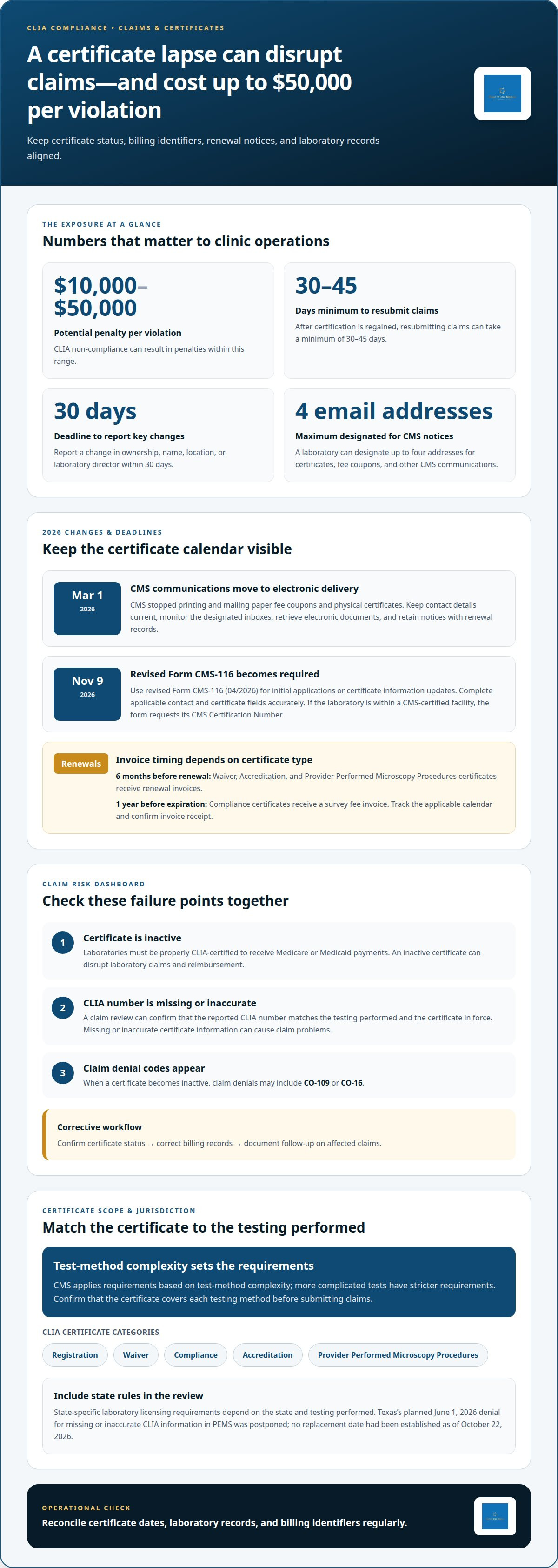
An inactive CLIA certificate can disrupt laboratory claims and reimbursement. Laboratories must be properly certified under CLIA to receive Medicare or Medicaid payments. Missing or inaccurate certificate information can also cause claim problems. Include certificate status in billing checks, not just laboratory documentation reviews. A claim review can confirm whether the reported CLIA number matches the testing performed and the certificate in force.
Certificate categories include Registration, Waiver, Compliance, Accreditation, and Provider Performed Microscopy Procedures. Waiver, Accreditation, and Provider Performed Microscopy Procedures certificates receive renewal invoices 6 months before renewal; Compliance certificates receive a survey fee invoice 1 year before expiration. Match the renewal calendar to the certificate type and track invoice receipt.
CMS moved CLIA certificates and fee communications to electronic delivery in 2026. Starting March 1, 2026, CMS stopped printing and mailing paper fee coupons and physical certificates. A laboratory can designate up to four email addresses for CLIA certificates, fee coupons, and other CMS communications. Keep contact details current and use applicable CMS certificate access resources to retrieve electronic documents. Assign someone to monitor those inboxes and retain each notice with renewal documentation.
For initial applications or certificate information updates, laboratories must use revised Form CMS-116 starting November 9, 2026. The revised form is CMS-116 (04/2026). Complete the applicable fields accurately, including laboratory contact information and certificate details. When the laboratory is within a CMS-certified facility, the form requests its CMS Certification Number. A change in ownership, name, location, or laboratory director must be reported within 30 days, according to the Centers for Medicare & Medicaid Services.
Common claim risks include an inactive certificate, a missing CLIA number, or inaccurate information. CLIA non-compliance can result in penalties ranging from $10,000 to $50,000 per violation. Claim denials may include CO-109 or CO-16 when a certificate becomes inactive. After certification is regained, resubmitting claims can take a minimum of 30-45 days. Use a corrective workflow: confirm certificate status, correct billing records, and document follow-up on affected claims.
State-specific laboratory licensing rules depend on the state and the testing performed. Include the applicable state requirements alongside federal CLIA requirements in the clinic’s compliance review. Texas illustrates why jurisdiction-specific updates matter: a planned June 1, 2026 denial for missing or inaccurate CLIA information in PEMS was postponed, and no replacement date was established as of October 22, 2026.
CMS bases CLIA requirements on test-method complexity, with more complicated tests subject to stricter requirements. Confirm that the certificate covers each testing method before submitting claims. Then regularly reconcile certificate dates, laboratory records, and billing identifiers. This can help identify a lapse before it affects claims or requires a corrective response.
Staff qualifications and competency assessments
CLIA staff requirements depend on the test method and laboratory certificate. The Centers for Medicare & Medicaid Services sets stricter requirements for more complicated testing. Map each test to its complexity category, then assign personnel whose qualifications fit the applicable role. Keep role assignments, training records, and testing authorizations together. This creates a clear record of who may perform, review, and report each test.
CLIA mandates initial and ongoing competency assessments for laboratory staff. Testing personnel need an annual competency assessment. Laboratory directors must complete 20 hours of continuing medical education in laboratory management annually, according to the supplied CLIA compliance facts. Record each assessment’s date, reviewer, test method, findings, and any follow-up. For example, an assessment can identify whether an employee needs further instruction before handling a testing procedure independently.
Use a consistent assessment process for each person and method. First review training and qualification records. Then document observed work, the review of results and quality-control records, and how the employee responds to problems. Link any performance gap to a corrective action, such as targeted retraining, followed by a documented reassessment. Keep evidence easy to retrieve by personnel name and test method. Clear records help laboratory leaders distinguish a training issue from a process or equipment issue.
Clinics should maintain quality-control, proficiency-testing, and quality-assessment records. Keep testing results, review findings, corrective actions, and follow-up documentation together. The checklist states that documentation of quality-control and quality-assurance activities should be retained for two years. Record assessment results separately from routine quality-control data so supervisors can review both individual competency and broader laboratory performance.
Quality assurance and performance improvement are most useful when findings lead to specific actions. For each recurring issue, document the problem, likely cause, corrective step, responsible person, and outcome review. A recurring control failure, for example, may warrant reviewing staff technique, written procedures, and equipment records. This connects personnel development with laboratory operations without treating every error as an individual training problem.
The FDA Quality Management System Regulation became effective on 2 February 2026 and aligns 21 CFR Part 820 with ISO 13485. It concerns medical device quality systems, while CLIA governs laboratory testing. Clinics should distinguish these frameworks when they use devices for testing: device-manufacturer quality requirements do not replace CLIA personnel and laboratory obligations. For automated testing, retain relevant instrument training and operational records with the associated method documentation.
Use a personnel record review to address gaps before they affect testing. Confirm that every active test has assigned personnel, current qualifications, documented initial training, and ongoing competency evidence. Track annual assessments by due date, then direct identified gaps to corrective action and reassessment. This practical sequence supports reliable operations and makes quality improvement traceable across staff, methods, and testing records.
Proficiency testing and corrective actions
Proficiency testing gives a laboratory an external check on testing performance by comparing reported results with expected results for submitted samples. Treat each event as a documented quality assessment, not a one-time exercise. Assign responsibility for enrollment, sample handling, result submission, and review. Keep event instructions, submitted results, evaluations, and follow-up actions together by analyte and testing method.
Use these checks to make participation and follow-up traceable:
- Confirm enrollment in a CMS-approved program. CLIA proficiency-testing participants should use an approved program and test samples under normal laboratory conditions, so results reflect routine operations.
- Track the schedule for each regulated analyte. CLIA proficiency testing requires three events per year for regulated analytes, while some analytes require two events per year; a schedule by analyte helps prevent missed events.
- Account for the required event samples. According to the Centers for Medicare & Medicaid Services, CLIA proficiency-testing events require five samples per event for regulated analytes.
- Use the routine testing process for event samples. Record who performed the testing, the method used, and the result submitted, so reviewers can trace the outcome to the laboratory’s usual workflow.
- Review every evaluation and document the response. A prompt review connects an unsatisfactory result with an identified cause, corrective action, and follow-up assessment.
A result outside expected performance calls for a documented investigation. Compare the event result with quality-control records, relevant instrument or method documentation, and the testing process used. Record the finding, likely cause, corrective action, and responsible person. For example, if the review identifies a procedural gap, document the change and any related staff training. Do not consider an action complete until its outcome has been reviewed.
CLIA corrective-action requirements include 42 CFR §493.1282. Use a consistent record structure for each event: preserve the program evaluation, investigation notes, corrective steps, and effectiveness review. CAPA effectiveness reviews are typically scheduled 30 to 90 days after implementation. The interval gives the laboratory a defined point to assess whether the action addressed the cause.
Keep the event record connected to the applicable test method and quality-assessment file. Review trends across events, such as repeated issues tied to one method or workflow, and send recurring findings for further assessment. If a finding could affect patient results or billing, document the review and operational response. This creates a clear trail from proficiency testing through corrective action and follow-up review.
What changed for laboratory compliance in 2026?
CLIA requirements for test validation, instrument calibration, maintenance, and laboratory procedures center on documented processes and performance. The applicable standards cover procedure manuals under 42 CFR §493.1251, verification and validation of analytic test systems under 42 CFR §493.1253, and analytic quality control under 42 CFR §493.1256. Keep these records connected to the test methods and equipment they support.
For 2026 readiness, maintain equipment logs that capture calibration, repairs, and preventive maintenance. Each entry should identify the instrument, work completed, date, and responsible person. A complete record helps the laboratory trace a testing issue to equipment history instead of relying on memory. Keep the log with the instrument’s operational documentation.
Use a repeatable equipment review process:
- Check calibration records. Confirm documentation reflects the calibration activity for each instrument and supports the laboratory’s testing process.
- Record repairs and service. Link service notes to the affected instrument so technical staff can review its history when results raise a concern.
- Track preventive maintenance. Document completed maintenance and identify overdue work through the laboratory’s tracking process.
- Review equipment issues against test records. Connect instrument concerns with relevant quality-control results and corrective actions to support a traceable investigation.
Calibration and maintenance records are useful when they inform laboratory decisions. If an instrument issue coincides with an unexpected result, the laboratory can review service history, testing records, and applicable procedures together. Document the finding and response. This creates a clear record for technical review and helps the director assess whether laboratory operations need further attention.
Procedure control is another part of readiness. Document and regularly update standard operating procedures for every test method. The Electronic Code of Federal Regulations identifies laboratory procedure-manual requirements in 42 CFR §493.1251. Each procedure should describe the laboratory’s method and align with the equipment and workflow in use. Retain discontinued laboratory procedures for two years, so earlier testing practices remain traceable.
When testing uses more than one system, evaluate system correlation twice yearly. Record the systems compared, the review, and any follow-up. This provides a structured way to assess whether methods produce comparable results across equipment. For automated hematology assays, the checklist specifies two levels of controls every eight hours. Apply that detail only to the stated assay context, not to unrelated tests.
Laboratories should be prepared for inspections and potential penalties for non-compliance. Keep calibration, repair, maintenance, validation, and procedure records organized for operational review. A practical sequence is to identify each active instrument, connect it to its test methods, and review its records alongside current procedures. The laboratory director can then address gaps through documented corrective action, rather than leaving equipment history separate from testing decisions.
Clinic CLIA compliance checklist
Physician office laboratories and clinics must maintain a current CLIA certificate for the testing they perform. A Certificate of Waiver generally authorizes waived testing only; moderate-complexity tests require appropriate nonwaived certification and applicable compliance. The Association of Public Health Laboratories identifies CLIA laboratory requirements in 42 CFR Part 493, the Laboratory Requirements.
Patient identification, specimen handling, and result reporting should follow documented procedures for each test method. Monitor temperature-controlled spaces each day they are used, retain test requisitions for two years, and retain test reports, including instrument printouts and reference-laboratory reports, for two years. These records help connect each result to the testing process.
Use this operational checklist to review the facility’s program:
- Match each test to the certificate. Confirm the certificate covers the level of testing performed at the facility, because a waived certificate does not authorize moderate-complexity testing.
- Review the procedure manual. The Electronic Code of Federal Regulations covers laboratory procedure-manual requirements under 42 CFR §493.1251, supporting consistent methods and staff practice.
- Keep certificate details current. Report changes in ownership, name, location, or laboratory director within 30 days, according to the Centers for Medicare & Medicaid Services.
- Track testing changes. A Waiver or Provider Performed Microscopy Procedures certificate holder must report a change in testing immediately; other specified certificate holders have separate reporting timelines.
- Review records by test type. Retain immunohematology reports for five years and pathology and Pap smear reports for ten years, as specified in the checklist facts.
- Document orders and procedures. Follow an oral laboratory test order with a written request within 30 days, and retain discontinued procedures for two years.
For 2026, laboratories applying for an initial certificate or updating certificate information must use revised CMS-116 starting November 9, 2026. Keep the application information aligned with the facility’s current testing and certificate details. Since CMS communications and certificates moved to electronic delivery in 2026, assign responsibility for receiving and retaining those records. This keeps renewal notices and certificate documentation accessible to the staff managing laboratory operations.
Use corrective actions to close documented gaps. Record the issue, the responsible person, the action taken, and the follow-up review. Then organize the checklist evidence by test method, certificate, and facility location. To support clinic testing workflows, review available rapid testing supplies.
Point of Care Medical: SURE CHECK HIV 1/2 Assay
Point of Care Medical offers the SURE CHECK HIV 1/2 Assay for clinics reviewing their testing needs. Consider it when evaluating whether an HIV assay fits the clinic’s testing program and operational workflow. Before adding any test, align the method with the facility’s CLIA certificate, procedures, staff competency records, and quality-control process. This keeps procurement decisions connected to compliance requirements rather than treating supplies as a separate task.
Point of Care Medical also offers GenBody COVID-19 Rapid Antigen Test, ViraDx™ SARS-CoV-2/Flu A+B Rapid Antigen Test, and Rapid Test Cup “RTC” + Fentanyl. These offerings address distinct testing needs, so select products based on the clinic’s planned testing and applicable requirements.
For information about products relevant to your clinic’s testing program, contact Point of Care Medical.
Make your next testing decision operational
Turn the CLIA compliance checklist for clinics 2026 into a working tool for future changes, not just a record of current status. Before adding a test or changing a workflow, document who owns the decision, which procedures need review, and how staff will be prepared. This makes compliance part of routine planning and helps keep operational changes connected to the clinic’s quality process.
Choose testing supplies that align with your clinic’s planned use and established procedures. Point of Care Medical supplies diagnostic tests, including respiratory, infectious disease, and toxicology products for healthcare and screening facilities. Product selection supports the workflow, while the clinic remains responsible for matching testing to its applicable CLIA certificate and requirements.
As your testing needs evolve, contact Point of Care Medical to discuss the available offerings. A clear process and a suitable supply plan can help your team move forward with confidence.
Frequently Asked Questions
What Is CLIA and Who Needs to Comply?
CLIA, the Clinical Laboratory Improvement Amendments, sets federal standards for facilities testing human specimens in the United States. It applies when testing supports health assessment or helps diagnose, prevent, or treat disease. This includes physician office laboratories and clinics, not just dedicated diagnostic laboratories. A clinic should assess each test it performs because its certificate and operating requirements depend on the testing involved.
Do all labs need to follow the same regulatory checklist in 2026?
No. A laboratory’s checklist depends on its certificate, test complexity, and testing activities. A CLIA compliance checklist for clinics 2026 should reflect whether the clinic performs waived, moderate-complexity, or high-complexity testing. State requirements can also add to federal CLIA obligations. Organize the review by test method and location, then connect each item to responsible personnel and records. This helps a clinic avoid relying on one generic checklist for different operations.
How should small or remote labs approach quality checklists?
Small or remote labs can use a shared, method-based checklist with clear ownership for each task. Keep current procedures, equipment records, quality-control documentation, staff training evidence, and corrective actions organized and accessible to responsible personnel. For a clinic with limited testing, start with its active methods and certificate scope. Review changes to instruments, personnel, or testing workflow as they occur, and record the resulting decisions.
What’s new?
In 2026, CMS moved CLIA certificates and fee communications to electronic delivery, ending paper certificate and fee coupon mailings starting March 1. Laboratories should maintain current contact information and monitor designated email accounts for program communications. Starting November 9, 2026, laboratories applying for an initial certificate or updating certificate information must use revised Form CMS-116. Keep electronic certificate records accessible to staff handling laboratory administration.
How do clinics determine whether a test is waived, moderate complexity, or high complexity under CLIA?
Clinics should identify the CLIA complexity classification assigned to each test system, then ensure the facility’s certificate covers that testing. A Certificate of Waiver generally authorizes waived testing only. Moderate-complexity testing requires appropriate nonwaived certification and compliance with applicable requirements. If a clinic adds a test or changes methods, reassess certificate scope before using it. Record the test’s classification and the clinic’s decision in its method documentation.
How do clinics apply for a CLIA certificate, and what forms and steps are required?
Clinics apply using Form CMS-116, which collects information about the laboratory and its testing. Starting November 9, 2026, initial applications and certificate-information updates must use the revised form. Prepare accurate facility, contact, and testing details, then submit the application through the applicable process. For a laboratory within a CMS-certified facility, the form requests its CMS Certification Number. Keep a copy of the submitted form with certificate records.
What personnel qualifications and training records are required for each CLIA testing complexity level?
Personnel requirements depend on the certificate and complexity of testing performed, so a single qualification standard does not fit every role. Maintain records that connect each staff member to assigned methods, training, and competency evidence. CLIA requires initial and ongoing competency assessments for laboratory staff; testing personnel need annual assessments. Laboratory directors must complete 20 hours of continuing medical education in laboratory management annually. Document follow-up when an assessment identifies a gap.
What CLIA inspection and survey requirements apply to clinics, and how should they prepare?
Survey requirements depend on the certificate type. Laboratories with Certificates of Compliance or Accreditation are surveyed every 2 years. A laboratory with a Certificate of Registration for non-waived testing typically has an initial survey in its first year, while Waiver and Provider Performed Microscopy Procedures laboratories are not routinely surveyed. Use a CLIA compliance checklist for clinics 2026 to organize current procedures, testing records, staff documentation, and corrective-action evidence for review.


