

A larger stockroom alone won’t prevent a medical test shortage. Managing medical test supply chain disruptions means forecasting demand, setting reorder points that account for lead times, and coordinating purchasing, laboratory, and clinical teams before supplies run low. Hospitals can reduce the impact of disruptions, but no inventory plan can prevent every supplier or transport problem.
Demand can change quickly, and a delay in one essential test can affect workflows across departments. Accurate forecasts and automated reordering help teams spot inventory risks early. Clear ownership also makes it easier to respond when orders are delayed or demand shifts.
This article explains how hospitals can use inventory data to anticipate demand, build practical reorder processes, and coordinate responses across teams. It also covers how scenario planning, supplier visibility, and backup arrangements can support continuity when normal supply routes are disrupted.
Key Takeaways
- Use inventory records and demand patterns to identify test supplies that need closer monitoring and more deliberate forecasting.
- Combine shipment, stock, and supplier information to spot bottlenecks early and adjust plans as conditions change.
- Coordinate manufacturers, distributors, purchasing teams, laboratories, and clinical staff so supply changes reach the people who need to respond.
- Set automated reorder triggers around demand, lead times, and item criticality to help reduce stockout and overstock risks.
- Build cross-functional disruption plans that identify dependencies, backup sources, and clear ownership before a shortage occurs.
Hospital inventory tracking and demand forecasting
Healthcare organizations can forecast demand for medical test supplies by combining usage history, current inventory, patient volumes, and supplier lead times. Review these inputs by test type, and update forecasts when clinical activity or public health conditions change.
Forecasting Volatile Demand
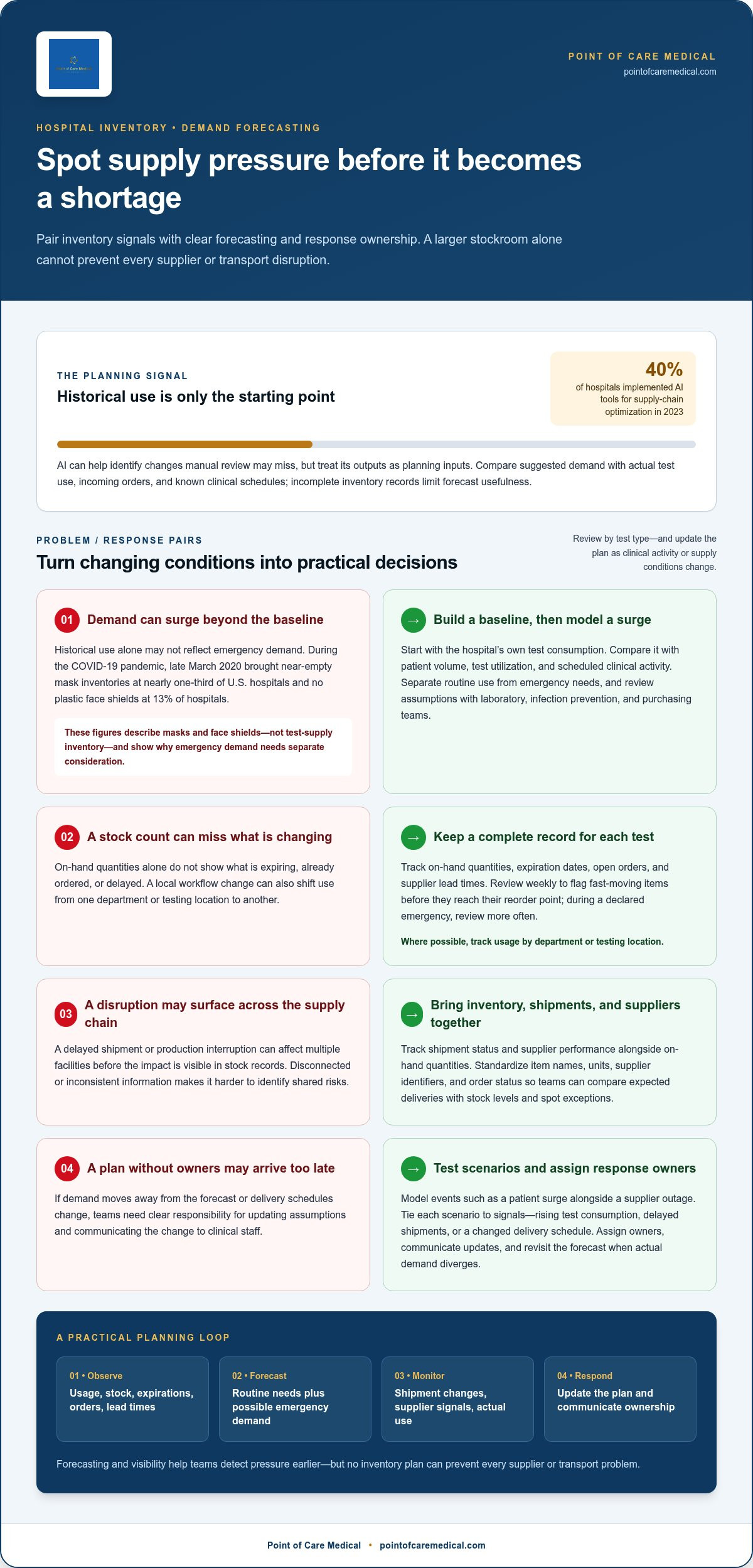
Volatile demand means supply needs can shift quickly as patient volumes and health events change. During the COVID-19 pandemic, demand for testing supplies rose alongside demand for protective equipment, while late March 2020 brought near-empty mask inventories at nearly one-third of U.S. hospitals and no plastic face shields at 13% of hospitals. These figures show why historical usage alone may not reflect emergency demand.
Build a baseline from the hospital’s own test consumption, then compare it with changes in patient volume, test utilization, and scheduled clinical activity. Separate routine use from emergency demand so the forecast shows which inventory supports day-to-day operations and which supplies may be needed during a surge. Review assumptions with laboratory, infection prevention, and purchasing teams. In January 2024, U.S. healthcare providers still faced shortages of hundreds of products, a reminder that routine planning must account for supply constraints as well as patient demand.
Maintain an inventory record for each test type that captures on-hand quantities, expiration dates, open orders, and supplier lead times. A weekly review can flag fast-moving items before they reach their reorder point. During a declared emergency, review records more often. Track usage by department or testing location when possible to distinguish a hospital-wide demand increase from a local change, such as a testing workflow moving to another unit.
AI-powered forecasting can analyze inventory and consumption patterns to identify changes that manual review may miss. In 2023, 40% of hospitals implemented AI tools for supply chain optimization. Treat AI outputs as planning inputs: compare suggested demand with actual test use, incoming orders, and known clinical schedules before adjusting replenishment. A model cannot make a useful forecast from incomplete inventory records, so accurate item data and consistent usage entries remain essential.
Scenario Planning for Supply Needs
Scenario planning tests how different events could affect medical test demand and supply. For example, a hospital can model a patient surge alongside a supplier outage, then estimate which test inventories would come under pressure first. Comparing scenarios helps teams set practical reserve levels and agree on response steps before a disruption affects patient care.
Tie each scenario to measurable signals, such as rising test consumption, delayed shipments, or a supplier’s changed delivery schedule. Assign owners to update assumptions and communicate changes to clinical teams. If actual demand diverges from the plan, revisit the forecast rather than waiting for a stockout. This connects forecasts to inventory decisions and gives staff a clear basis for adjusting orders as conditions change.
Can You Prevent Supply Chain Disruptions in Life Sciences?
Hospitals can’t prevent every disruption, but supply chain visibility helps teams detect pressure earlier and respond with more information. Healthcare supply chain processes should account for requirements intended to reduce the risk of flawed medical products.
Real-Time Supply Chain Tracking
Real-time tracking brings together current inventory, shipment status, and supplier performance to reveal emerging supply risks. A delayed shipment or production interruption can affect several facilities before stock records show the impact. Track order changes and delivery updates alongside on-hand quantities so purchasing teams can respond earlier and adjust operational plans with better information.
Cloud-based platforms can bring inventory, shipment, and supplier information into one view. Teams can compare expected delivery dates with stock levels and identify items affected by the same supplier or route. A survey of 103 U.S. hospital and health system leaders informed an estimate that nearly 70% of hospitals may have adopted cloud-based supply chain management by 2026. Shared visibility helps purchasing, laboratory, and clinical teams work from consistent updates.
Visibility depends on reliable data. Standardize item names, units, supplier identifiers, and order status across procurement and inventory processes. Assign responsibility for correcting duplicate records and updating shipment changes. If one department records test kits by case and another by individual unit, the combined inventory view can misstate available stock. Consistent records make exceptions easier to spot and forecasts more useful.
Disaster planning should connect supply data to response decisions. Hurricane Helene disrupted approximately 60% of the national IV fluid supply in 2024, and more than 80% of U.S. healthcare organizations faced shortages after Baxter’s North Carolina plant disruption. Hospitals can include supplier outages and route interruptions in emergency exercises. Use each scenario to identify affected products, responsible decision-makers, and the information teams need to prioritize available inventory.
Rules for Shortages and Substitutions
Federal requirements shape how healthcare organizations manage product quality and supply-chain processes during shortages. Healthcare supply-chain processes should align with the DSCSA, while FDA requirements aim to reduce the risk of flawed medical products. These requirements inform compliance practices, but they do not establish a blanket substitution rule for every medical test.
For a proposed substitute, route the decision through the hospital’s established quality and regulatory review. Compare product labeling, intended use, and operational requirements before changing procurement or clinical workflows. Keep the decision and supporting product information accessible to affected teams. For inventory planning, teams can also review medical test supply options alongside their forecast and approved purchasing processes.
How did COVID-19 impact the healthcare supply chain?
COVID-19 exposed how quickly testing supply shortages can spread across healthcare systems. Hospitals, manufacturers, distributors, and providers need active communication and planned alternatives to mitigate similar pressure.
During the pandemic, shortages affected testing supplies, personal protective equipment, dialysis materials, pharmaceuticals, and other products used in care. Sharp demand increases also strained suppliers and led to temporary import and export restrictions. At least 80 countries and separate customs territories introduced export prohibitions during the COVID-19 pandemic. These conditions made coordination essential, not optional.
Checking Substitute Supply Quality
Before bringing a substitute into clinical workflows, review its intended use, product information, and quality controls. A replacement can introduce quality or operational risks if teams assume it is interchangeable without review.
Compare the substitute’s labeling and specifications with the testing need, then document the review and decision. FDA requirements aim to reduce the risk of flawed medical products. Standardized quality management systems and certification processes aligned with ISO standards can support consistent product quality and help reduce regulatory delays. These controls help teams assess which products are suitable for review instead of assuming every available test is an acceptable substitute.
Securing Alternative Testing Suppliers
Identify potential suppliers before a shortage and establish a clear process for evaluation and purchasing. Hospitals can build relationships in advance, add suppliers to approved vendor lists, and assign purchasing as the coordination contact.
These steps help teams move faster when a primary source is disrupted. During the COVID-19 pandemic, hospitals and health systems reached out to thousands of manufacturers, community groups, and nontraditional suppliers. Early supplier involvement can clarify production constraints, expected lead times, and product information before orders become urgent. Keep the contact list and approval status accessible to purchasing, laboratory, and clinical teams.
Communication must continue after a supplier is approved. Hospitals should share changes in demand and ask suppliers and distributors to report delays, production constraints, and shipment changes. A survey of hospital purchasing leaders found that 76% cited supplier reliability as a top value driver for their teams. Regular updates give providers a basis for adjusting orders and prioritizing available stock.
Partnerships also need clearly defined roles. Designate a department to coordinate alternative suppliers and donors, then specify how product information reaches quality reviewers and end users. During the pandemic, some health systems lacked adequate national or regional stockpiles, while some joint procurement agencies lacked capacity. A hospital-level contact and documented escalation path can reduce confusion when several teams seek the same scarce supplies.
Maintain a shared record of supplier contacts, product reviews, order status, and unresolved questions. Manufacturers can report production changes, distributors can share shipment updates, and providers can communicate changing requirements. Exchanging this information helps each party respond to shortages consistently and supports a more orderly review of alternatives.
Inventory management and automated reordering
Automated reordering connects inventory levels with usage, supplier lead times, and reorder points. Diagnostic supplies are most vulnerable when they are essential to patient care and have few substitutes, constrained production, or long transport routes.
Critical Inventory and Buffer Stock
Critical inventory is the supply needed to sustain essential testing when normal replenishment is disrupted. Buffer stock provides a reserve while teams address a delayed order or sudden change in demand. Set reserve levels according to each test’s clinical importance, availability of substitutes, expected usage, and replenishment lead time. A test with no practical alternative may need closer monitoring than one with multiple approved options.
Automated reordering can flag items approaching their reorder points and prompt or generate replenishment according to configured rules. Base those rules on recorded usage, available stock, open orders, and supplier lead times. If a shipment is delayed, for example, the system can show the gap between expected arrivals and projected consumption. Staff can then review the order and prioritize supplies according to clinical need.
Buffer stock needs active oversight. Track expiration dates and rotate stock so reserve supplies remain usable instead of becoming waste. Review reserve levels when testing patterns change or suppliers report production constraints. A reserve plan that ignores shelf life, storage requirements, or changing demand can create excess stock without improving resilience.
Inventory Management Challenges
Common inventory management problems include incomplete usage records, inconsistent units, delayed updates, and orders that no longer reflect demand. These issues matter because automated systems depend on accurate inputs. If one department records individual tests and another records boxes, the combined count may misrepresent usable stock and trigger a poorly timed reorder.
Medical test supplies face greater risk when they are critical and substitutes are limited. Risk also increases when production depends on scarce inputs or tightly coupled processes, or when supplies travel long distances. A disruption to a reagent input or shipment route, for example, can constrain availability even if recent hospital usage is stable. Classify items by criticality and substitution options, then monitor the highest-impact supplies more closely.
AI-enabled inventory tools can identify changing usage patterns and flag potential disruptions for review. Their value depends on accurate product records, consistent unit definitions, and timely updates to receipts and consumption. Assign staff to resolve data exceptions and compare forecasts with actual orders. Treat AI alerts as decision support, and adjust reorder settings when patient demand, supplier performance, or inventory conditions change.
Use regular reviews to connect system alerts with purchasing and laboratory decisions. Check that stock counts match physical inventory, open orders are current, and reorder thresholds reflect present lead times. This helps organizations balance continuity against overstock while maintaining documented, regulatory-aware controls for test supplies and related devices.
Cross-functional supply chain risk management
Supply-chain resilience depends on decisions that connect procurement, laboratory operations, clinical leadership, finance, and emergency management. Each team sees a different risk: purchasing tracks supplier changes, laboratories assess test requirements, and clinical leaders weigh patient-care impact. A shared process turns these signals into coordinated action. Assign an owner to gather updates, identify affected supplies, and bring decisions to the teams responsible for responding. This coordination is central to managing medical test supply chain disruptions across hospital functions.
Start by mapping dependencies for each critical test supply. Record the manufacturer, distributor, production inputs, transport route, and available alternatives. A 2021 Suez Canal blockage delayed critical medical shipments, showing how a route disruption can affect products far from its origin. Map indirect dependencies too, such as a reagent component supplied to a test manufacturer. This view helps teams identify where a disruption could spread before it reaches hospital inventory.
Set escalation triggers and decision rights before a shortage occurs. A supplier delay, for example, can prompt purchasing to assess open orders, laboratory leadership to estimate workflow impact, and clinical leaders to prioritize testing needs. Define who can approve an alternative source and who communicates changes to affected departments. Clear responsibilities prevent teams from acting on conflicting information or placing duplicate orders.
Use cross-functional exercises to test these arrangements. A tabletop scenario can simulate a supplier outage, transport interruption, or unexpected production constraint. Ask each team to identify its first decision, required information, and communication route. During the pandemic, information infrastructure for fair allocation across countries or regions proved insufficient. Hospitals can strengthen their own response by recording exercise findings, assigning corrective actions, and updating plans as supplier conditions change.
Supplier diversification and local sourcing can reduce dependence on one production region, but they require coordinated review. In 2024, 20% of hospitals shifted to local sourcing to mitigate global supply chain risks. Evaluate sourcing changes alongside product quality review, purchasing controls, and laboratory workflow needs. Keep a current list of approved alternatives and a designated contact for supplier coordination. Revisit the list as production, transport, or demand conditions change.
Make the risk review a standing operational process, not a document used only during emergencies. Purchasing can report supplier signals, laboratory teams can flag changing test requirements, and leadership can resolve competing priorities. Treat managing medical test supply chain disruptions as an ongoing governance responsibility, with owners reviewing decisions and updating plans as conditions shift. To align test supply planning with operational needs, review rapid testing supply options as part of your organization’s procurement planning.
Point of Care Medical: GenBody COVID-19 Rapid Antigen Test
Point of Care Medical offers the GenBody COVID-19 Rapid Antigen Test for hospitals sourcing COVID-19 rapid antigen tests. It can be considered when teams are reviewing test inventory and planning replenishment for their testing needs. The available offerings also include the ViraDx™ SARS-CoV-2/Flu A+B Rapid Antigen Test, SURE CHECK HIV 1/2 Assay, and Rapid Test Cup "RTC" + Fentanyl. Each addresses a different testing category, so match the product to the hospital’s intended use and purchasing requirements.
Include relevant test supplies in procurement planning alongside demand forecasts and inventory reviews. For product information, visit Point of Care Medical.
Make Supply Continuity Part of Routine Planning
Supply resilience improves when disruption planning is part of routine operational governance. Assign a cross-functional owner to maintain escalation paths, record decisions, and translate supplier updates into actions for clinical teams. Use each procurement cycle to review whether assumptions still match current testing needs. This keeps continuity planning connected to daily decisions instead of isolated in an emergency document.
For hospitals refining their approach to managing medical test supply chain disruptions, the next step is to align purchasing plans with the tests their teams use. Point of Care Medical offers the GenBody COVID-19 Rapid Antigen Test, ViraDx™ SARS-CoV-2/Flu A+B Rapid Antigen Test, and Rapid Test Cup "RTC" + Fentanyl. These offerings can inform relevant test-supply procurement planning.
Explore Point of Care Medical’s test supply offerings as you plan your next procurement review. A clear, repeatable process gives teams a practical foundation for strengthening continuity over time.
Frequently Asked Questions
Why care about medical supply chains?
Medical supply chains affect whether clinicians can deliver planned care with appropriate products. A missing test can delay decisions, while an unreviewed replacement can introduce workflow or quality risks. Supply continuity also affects how staff allocate available tests across departments. For example, a hospital with clear stock visibility can identify which services depend on a particular assay and coordinate priorities before patients arrive for scheduled testing.
What causes medical test supply chain disruptions?
Disruptions can result from demand surges, production constraints, scarce manufacturing inputs, supplier outages, or transport interruptions. Dependence on a single production source can make a product vulnerable even when demand is stable. Trade restrictions and infrastructure damage can also interrupt cross-border supply. A test’s exposure depends on its components, manufacturing locations, supplier network, and transport route. Mapping these dependencies helps hospitals identify risks beyond their direct vendor.
How should organizations prioritize tests during supply shortages?
Prioritize supplies by clinical importance, patient impact, available alternatives, and replenishment time. Clinical and laboratory leaders can identify tests that support urgent decisions, then define how limited stock will be allocated across departments. A hospital might reserve a constrained assay for time-sensitive cases while reviewing whether other workflows can use a clinically appropriate alternative. Document the rationale and communicate allocation decisions consistently.
What are the costs of emergency procurement and maintaining safety stock for test supplies?
Emergency procurement can involve higher purchase costs, expedited transport, staff time, and additional review of unfamiliar products. Safety stock ties up working capital and may require more storage, tracking, and rotation to manage expiration. The balance depends on each test’s criticality, supplier lead time, demand variability, and shelf life. Compare these factors by item instead of applying one reserve policy to every test category.
How should labs manage inventory and monitor supply chain risks?
Laboratories should reconcile physical counts with inventory records, track lot and expiration details, and review consumption alongside open orders. A practical risk log can capture supplier changes, delayed shipments, product-specific dependencies, and the staff member responsible for follow-up. For example, flag a supplier’s revised delivery date against the laboratory’s planned testing schedule. Regular reviews with purchasing help keep operational records aligned with laboratory requirements.
What lessons have healthcare systems learned from recent diagnostic test supply shortages in the United States?
Recent shortages have shown that hospitals need allocation plans as well as procurement plans. During the pandemic, information infrastructure for fair allocation across regions was insufficient. Hospitals can strengthen preparedness by defining how limited tests move among facilities, documenting who approves transfers, and sharing shipment priorities with logistics partners. Including these decisions in emergency exercises helps teams identify gaps before competing needs arise.


