

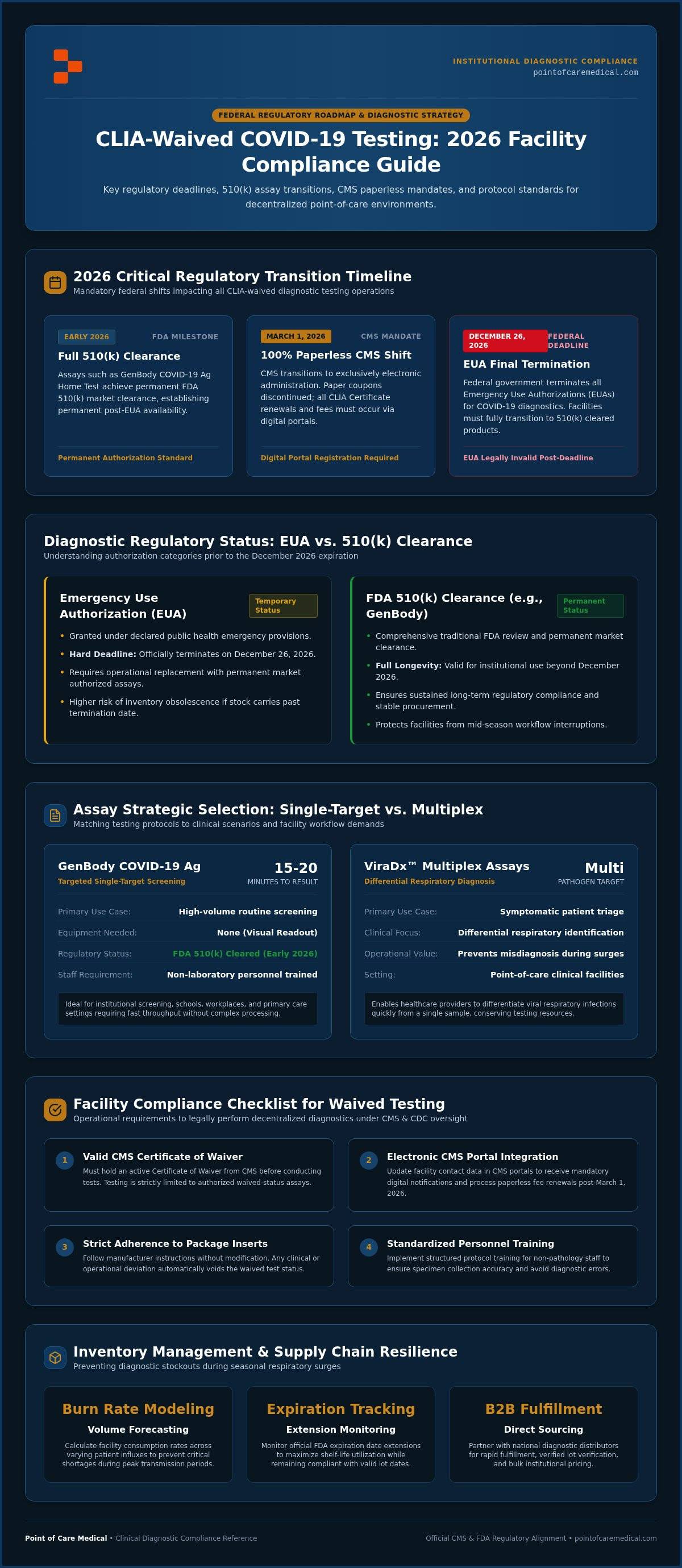
By December 26, 2026, the federal government will officially terminate all Emergency Use Authorizations for COVID-19 diagnostics. This regulatory shift forces clinical facilities to re-evaluate their reliance on temporary authorizations when selecting a CLIA waived COVID antigen test. You likely understand that maintaining compliance isn't just about filing a certificate. It's about managing a continuous workflow amid changing CMS mandates and fluctuating patient volumes. Navigating these federal updates while training non-laboratory staff for high-accuracy results creates significant operational pressure for administrative leaders.
This guide provides a definitive checklist for 2026 facility compliance. You'll learn how to master the regulatory requirements and procurement strategies necessary for a high-performance diagnostic program. We'll cover the transition to mandatory paperless CMS notifications, the procurement of 510(k) cleared products like GenBody, and strategies for maintaining accuracy during respiratory surges. This overview ensures your facility moves from reactive testing to a streamlined, professional diagnostic operation that prioritizes both regulatory precision and logistical efficiency.
Key Takeaways
- Navigate the 2026 transition from Emergency Use Authorizations to full FDA 510(k) clearance to ensure long-term regulatory stability.
- Establish a robust compliance framework by implementing standardized personnel training and maintaining a valid CLIA waived COVID antigen test Certificate of Waiver.
- Compare the logistical benefits of high-volume GenBody assays against ViraDx™ multiplex tests for more effective differential diagnosis.
- Master inventory management by calculating facility burn rates and monitoring expiration extensions to prevent stockouts during peak respiratory seasons.
- Streamline procurement through a national B2B partner that specializes in rapid fulfillment and verified diagnostic quality for clinical environments.
What is a CLIA-Waived COVID Antigen Test?
A CLIA waived COVID antigen test represents a category of diagnostic tools cleared for use outside of traditional, high-complexity laboratory settings. These tests fall under the Clinical Laboratory Improvement Amendments (CLIA), which establish federal standards for all U.S. clinical testing. To receive a waived designation, a test must demonstrate a simple methodology and a negligible risk of erroneous results. This allows clinical facilities to provide rapid diagnostics without the overhead of a full-scale pathology lab.
The FDA regulates these diagnostics by granting either Emergency Use Authorization (EUA) or traditional 510(k) clearance. As the industry moves toward the December 26, 2026, termination of COVID-19 EUAs, facilities must prioritize tests that have secured permanent market authorization. For example, the GenBody COVID-19 Ag Home Test received full 510(k) clearance in early 2026, ensuring its continued availability for institutional use after emergency declarations expire. Selecting a waived test ensures your facility can maintain screening protocols without the regulatory burden associated with moderate or high-complexity testing.
The Benefits of Waived Testing in 2026
Waived testing expands diagnostic capabilities into non-traditional environments like schools, workplaces, and primary care clinics. It eliminates the need for specialized laboratory personnel; non-pathologists can administer these tests accurately by following the manufacturer’s instructions. This decentralization facilitates immediate clinical decision-making through fast visual results, which is vital during seasonal respiratory surges. By using assays like GenBody or ViraDx, facilities can process high volumes of patients without sending samples to external labs, significantly reducing wait times and improving patient management.
Regulatory Oversight and Quality Standards
Oversight involves a coordinated effort between the CMS, FDA, and CDC to ensure diagnostic reliability. The waived category serves as the gold standard for decentralized testing because it balances clinical accuracy with operational simplicity. To legally perform these tests, your facility must obtain a Certificate of Waiver from CMS. This certificate permits you to perform only those tests that are specifically designated as waived.
Starting March 1, 2026, CMS transitioned to a fully paperless system for all CLIA-related administrative tasks. This means all certificate renewals and fee payments must occur through electronic portals; paper coupons are no longer mailed. Facilities should update their contact information with CMS immediately to ensure they receive mandatory digital notifications and avoid lapses in testing authority. Maintaining compliance requires strict adherence to the manufacturer's package insert, as any deviation can void the waived status of the test.
Selecting High-Performance Assays: GenBody and ViraDx
Choosing the right CLIA waived COVID antigen test requires balancing diagnostic precision with facility throughput. While many assays appear similar, their clinical utility varies based on patient symptoms and seasonal prevalence. Facilities must decide between single-target screening for routine surveillance and multiplex assays for symptomatic patients. Matching the assay to your specific patient population ensures that resources aren't wasted on unnecessary testing while maintaining high standards of care.
Technical specifications like sensitivity and specificity remain the primary benchmarks for selection. However, operational factors such as time-to-result and ease of specimen collection are equally vital for non-laboratory staff. Following CDC guidance on waived tests helps administrators understand that even simple assays require strict adherence to manufacturer instructions to prevent diagnostic errors. A well-chosen test suite reduces the burden on staff and provides reliable data for immediate clinical decisions.
GenBody COVID-19: The Standard for Targeted Screening
GenBody COVID-19 Rapid Antigen Tests serve as the foundation for high-volume screening programs. These tests prioritize operational speed, delivering clear visual results within 15 to 20 minutes. Because the GenBody assay received FDA 510(k) clearance in early 2026, it meets the permanent regulatory standards required beyond the December 2026 EUA termination deadline. Clinical staff can interpret results easily without supplemental equipment, which simplifies workflows in busy point-of-care settings. The kits are designed for bulk storage, allowing facilities to maintain large inventories with minimal space requirements.
ViraDx™ Multiplex Testing: Beyond COVID-19
ViraDx™ SARS-CoV-2/Flu A+B offers a distinct strategic advantage for facilities managing symptomatic patients. This multiplex assay provides three results from a single patient swab, identifying COVID-19, Influenza A, and Influenza B simultaneously. During peak respiratory seasons, this differential diagnosis is essential for appropriate patient management and infection control. It reduces the need for multiple swabs, which improves the patient experience and lowers per-patient consumable costs. Using a multiplex test like ViraDx™ streamlines the diagnostic process when symptoms overlap across different viral infections.
Administrators should evaluate their facility's typical patient acuity to select the most efficient assay for their needs. You can review professional diagnostic options to determine which assay fits your current screening volume and clinical requirements.
The Facility Compliance Checklist for Waived Testing
Implementing a CLIA waived COVID antigen test program requires a structured approach to meet federal CDC test complexity standards. Compliance is an active operational process, not a one-time administrative task. Facilities must align their daily workflows with CMS mandates to ensure diagnostic accuracy and legal standing. This checklist provides the essential steps for maintaining a compliant testing environment in 2026.
- Step 1: Certificate Management. Obtain and renew your Certificate of Waiver every two years. The biennial fee typically ranges from $180 to $248 depending on your state. Remember that as of March 2026, CMS no longer mails paper coupons; all payments must occur through the digital portal.
- Step 2: Personnel Training. Document training for every staff member who performs testing. This includes a review of the manufacturer’s instructions and a demonstrated competency assessment before they test their first patient.
- Step 3: Environmental Monitoring. Maintain a daily temperature log for the area where test kits are stored. Most assays, including GenBody and ViraDx, require specific temperature ranges to maintain reagent integrity.
- Step 4: Quality Control. Perform external control testing with every new shipment or lot number received. Use both positive and negative swabs to verify the test is performing as expected.
- Step 5: Public Health Reporting. Follow state-specific guidelines for reporting positive results. While federal reporting requirements have shifted, many local jurisdictions still mandate notification for respiratory surveillance.
Documentation and Record-Keeping
Accurate record-keeping is the primary defense during a CMS validation visit. Your testing log should include the patient’s unique identifier, the test date, the specific lot number used, and the expiration date of the kit. Facilities must retain all testing records, including quality control data and patient results, for a minimum of two years to satisfy federal inspection requirements. Standardizing your site-specific operating procedures ensures that every staff member follows the same protocol, which reduces the risk of diagnostic errors. Digital logs are preferred for their searchability and ease of backup.
Quality Control and Internal Audits
Quality control (QC) procedures verify that the test system is functioning correctly and that the operator is performing the test accurately. You should run external controls whenever a new operator begins testing or if you suspect a storage temperature deviation occurred. If a QC run fails, you must identify the cause and document the corrective action taken before resuming patient testing. While CMS rarely conducts routine inspections at waived sites, they do perform unannounced visits in response to complaints. Maintaining a "ready-to-inspect" binder with your current certificate, training logs, and QC data demonstrates organizational competence and stability.
Optimizing Bulk Procurement and Supply Chain Resilience
Procurement of a CLIA waived COVID antigen test requires a data-driven approach to inventory management. Facilities must prevent stockouts while avoiding the financial loss of expired diagnostic kits. Calculating a facility "burn rate"-the average number of tests used per week-allows administrators to set accurate reorder points. During peak respiratory seasons, these rates often triple. This necessitates a buffer stock that accounts for increased patient flow and potential shipping delays. Leveraging wholesale pricing for large-scale institutional budgets ensures that high-volume screening remains cost-effective throughout the fiscal year. A national distributor provides the scale needed to maintain these inventories even when regional demand spikes.
Expiration management remains a primary concern for procurement officers. You should implement a First-In, First-Out (FIFO) rotation strategy to ensure older stock is used before newer shipments. It's also vital to monitor the latest FDA guidance on expiration extensions. For example, GenBody COVID-19 Ag tests have frequently received shelf-life extensions as ongoing stability studies provide new data. A reliable national distributor will provide the most current information on these extensions, helping you avoid premature disposal of viable inventory. This proactive monitoring protects your facility's bottom line and ensures testing continuity.
Institutional Sourcing Strategies
Healthcare organizations with multiple locations often face fragmented procurement processes. Standardizing on a single assay brand, such as GenBody or ViraDx™, simplifies staff training and reduces the risk of user error across sites. Working with a national partner allows for split-shipments, which ensures each clinic receives its specific allocation without the need for internal redistribution. You should evaluate lead times and shipping reliability carefully. A consistent supply chain prevents the operational friction caused by switching between different test formats during a surge. This stability allows clinical staff to focus on patient care rather than learning new testing protocols.
Ensuring Product Authenticity and Quality
The rise of grey-market and counterfeit diagnostic kits poses a significant risk to facility compliance and patient safety. Using unverified supplies can lead to inaccurate results and potential CMS penalties during a validation visit. You must verify lot numbers and FDA clearance status through your distributor to ensure every kit meets federal standards. Point of Care Medical supports institutional integrity by maintaining a transparent supply chain for all respiratory diagnostics, including GenBody and ViraDx™ kits. This verification process eliminates the guesswork from procurement. You can view available bulk inventory to secure verified assays for your facility.
Strategic Diagnostics: Partnering with Point of Care Medical
Establishing a reliable procurement channel is the final step in mastering facility compliance. A CLIA waived COVID antigen test program succeeds only when the supply chain remains resilient against seasonal demand and regulatory changes. Point of Care Medical serves as a methodical logistics partner for institutional decision-makers. We prioritize frictionless workflow management by providing verified diagnostics that meet the latest federal standards. This partnership allows administrative leaders to focus on clinical outcomes rather than troubleshooting supply shortages or verifying technical specifications.
As the December 26, 2026, deadline for EUA termination approaches, facilities must transition to permanently authorized products. We facilitate this shift by maintaining a steady inventory of 510(k) cleared GenBody COVID-19 Rapid Antigen Tests. For facilities requiring differential diagnosis, we supply ViraDx™ SARS-CoV-2/Flu A+B multiplex assays. Our role extends beyond simple distribution; we provide the professional stability required to manage large-scale screening environments. By centralizing your diagnostic sourcing, you reduce the administrative burden of managing multiple vendors and disparate lot numbers.
Efficient Fulfillment for National Healthcare Systems
National healthcare networks and urgent care chains require a distributor with significant reach and disciplined fulfillment protocols. We offer streamlined ordering processes designed to handle high-volume institutional needs across multiple sites. Our team provides professional support for technical and regulatory inquiries, including guidance on the latest CMS paperless notification mandates. We're committed to maintaining a consistent supply of respiratory diagnostics during national health emergencies. This reliability prevents the operational downtime that occurs when facilities are forced to use unverified or unfamiliar test formats.
Contact Us for Wholesale Procurement
Securing a wholesale partner ensures your facility benefits from predictable pricing and verified quality standards. We offer direct access to a comprehensive suite of infectious disease diagnostic kits, including the SURE CHECK HIV 1/2 Assay and various Oral Fluid tests. Our catalog also includes customized solutions for specialized screening, such as the Rapid Test Cup "RTC" + Fentanyl for toxicology requirements. These professional-grade tools support a broad range of clinical objectives beyond respiratory care. You can secure your facility's diagnostic supply chain at Point of Care Medical to establish a long-term, low-friction procurement strategy. Our team is ready to assist with high-volume quotes and logistical planning for the 2026 fiscal year.
Future-Proofing Your Respiratory Testing Program
The transition from emergency authorizations to permanent FDA 510(k) clearance marks a significant shift in institutional diagnostic standards. Facilities must act now to ensure their CLIA waived COVID antigen test protocols remain compliant beyond the December 2026 deadline. Maintaining operational continuity requires more than just a valid certificate; it demands a disciplined approach to personnel training, digital CMS reporting, and inventory burn-rate calculations. By standardizing on high-performance assays like GenBody and ViraDx, clinical leaders can reduce diagnostic errors and simplify staff workflows.
Point of Care Medical stands as a quiet, capable ally in this transition. As a national US distributor and authorized supplier of GenBody and ViraDx, we provide the specialized institutional support necessary for high-volume screening. Our focus on fast fulfillment and supply chain integrity ensures that your facility remains prepared for any respiratory surge. You can Request a Wholesale Quote for CLIA-Waived Antigen Tests to stabilize your procurement for the coming fiscal year. Establishing a methodical supply strategy today ensures your facility stays focused on patient outcomes tomorrow.
Frequently Asked Questions
How do I apply for a CLIA Certificate of Waiver for my facility?
Complete Form CMS-116 and submit it to your local State Agency. As of March 1, 2026, all applications and fee payments must occur through the CMS digital portal, as paper coupons are no longer issued. You'll need to pay the biennial fee, which typically ranges from $180 to $248. Once approved, your facility can legally perform any CLIA waived COVID antigen test listed on the CMS waived test database.
Are CLIA-waived tests as accurate as laboratory-based PCR tests?
Antigen tests prioritize speed and accessibility over the high sensitivity of molecular PCR diagnostics. While PCR tests detect viral genetic material, antigen tests identify specific proteins on the virus surface. A waived test is designated as such because it has a low risk of an erroneous result when staff follow the instructions exactly. However, PCR remains the clinical standard for confirming negative results in highly symptomatic patients or high-risk settings.
Can non-medical staff perform CLIA-waived COVID antigen tests?
Yes, non-medical personnel can perform these tests if the facility holds a valid Certificate of Waiver. The regulations don't mandate specific professional degrees for operators of waived tests. However, the facility director must ensure all staff members receive proper training. You must document this training and conduct periodic competency assessments to verify that staff members can perform the test and interpret results accurately according to the manufacturer's protocol.
What should I do if my GenBody test kit controls fail?
Stop all patient testing immediately if the internal or external controls don't produce the expected result. A failed control indicates a potential issue with the test reagents, the storage environment, or the operator's technique. Review your daily temperature logs to check for deviations. You must document the failure and the corrective action taken before resuming testing. Contact your national distributor to report the lot number and request technical support for the GenBody assay.
How long are the results valid for CLIA-waived rapid tests?
Rapid antigen test results represent a point-in-time assessment of viral shedding. Most assays, including ViraDx and GenBody, require interpretation between 15 and 20 minutes after sample application. Results read after the manufacturer's specified window are invalid and shouldn't be used for clinical decisions. Because viral loads change rapidly, a negative result only indicates the absence of detectable protein at the moment of the swab; it doesn't guarantee the patient won't become infectious later.
Do I need a separate waiver for COVID and Flu testing?
You don't need separate certificates for different types of waived diagnostics. A single CLIA Certificate of Waiver covers all tests categorized as "waived" by the FDA, including both single-target COVID-19 tests and multiplex COVID/Flu assays. Your facility can perform an unlimited variety of these tests under one certificate. However, you must ensure that every specific test brand you use is officially listed in the FDA's waived database to maintain your facility's compliance status.
How can I check if a test kit's expiration date has been extended by the FDA?
Visit the FDA’s official "At-Home OTC COVID-19 Diagnostic Tests" webpage or consult your authorized distributor for the most current data. Manufacturers like GenBody frequently update shelf-life information as stability studies progress. The FDA maintains a searchable database that links specific lot numbers to their extended expiration dates. Always cross-reference your current inventory against these lists before disposing of kits, as many extensions add six to twelve months to the original printed date.
What are the reporting requirements for positive COVID-19 results in 2026?
Federal mandatory reporting requirements for every CLIA waived COVID antigen test performed will officially sunset with the termination of the public health emergency circumstances on December 26, 2026. However, state and local health departments often maintain their own surveillance mandates. Facilities should check their specific state reporting portals to determine if positive results still require notification. CMS also requires that all waived laboratories maintain a digital contact method for regulatory updates and potential survey notifications.


