

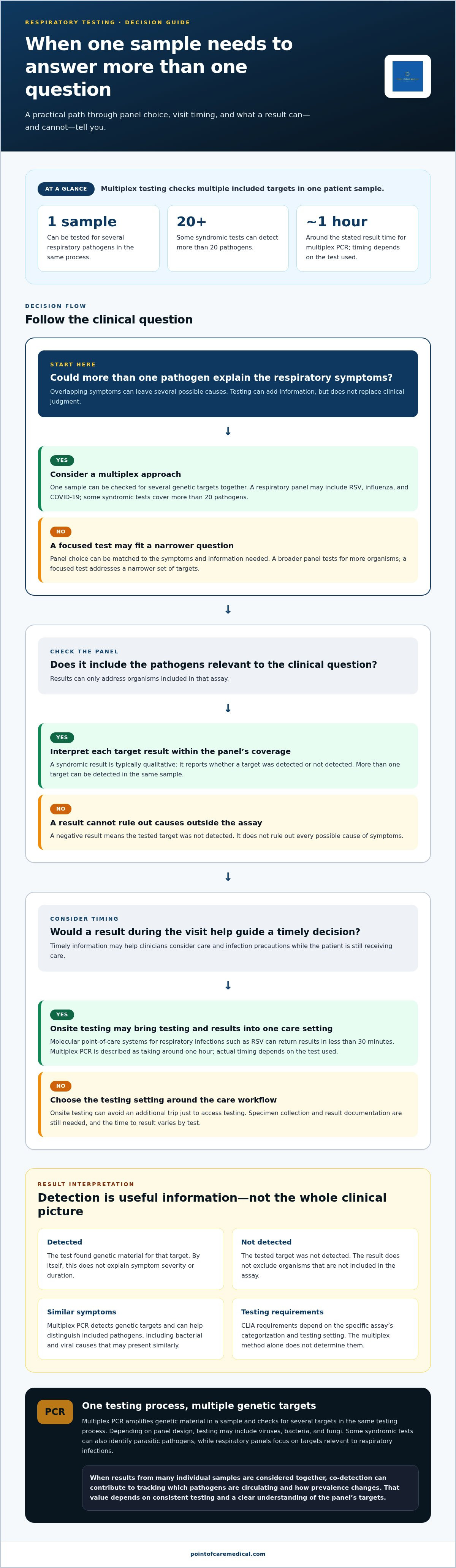
One respiratory sample can help answer several diagnostic questions at once. The benefits of multiplex respiratory POC testing include detecting multiple pathogens from a single sample and reducing the need for serial tests when symptoms could have more than one cause. Syndromic testing can identify more than 20 pathogens with one multiplex test.
Clinicians need timely, relevant results to guide decisions during a patient visit. No single test replaces clinical judgment, but testing can help identify which respiratory pathogen may be responsible and inform a focused next step.
This article explains how syndromic testing detects pathogens, how onsite point-of-care systems fit clinic workflows, and when multiplex testing may reduce sequential testing. It also covers practical limits: test type and panel coverage determine what a result can tell you.
Key Takeaways
- Understand how syndromic tests detect and identify multiple pathogens in one sample, and what co-detection can reveal.
- See how onsite testing can fit into clinic workflows and make visits more convenient for patients.
- Learn when a multiplex approach may reduce serial testing and reliance on reference-laboratory testing.
- Compare the practical limits of conventional laboratory methods and rapid antigen tests when selecting a testing approach.
- Explore how respiratory rapid antigen tests from Point of Care Medical may support focused testing needs in clinical and screening settings.
How are pathogens detected in syndromic testing?
Syndromic testing uses multiplex PCR to look for multiple pathogens in one patient sample, with results in around one hour. CLIA requirements depend on the specific assay’s categorization and testing setting; the multiplex method alone does not determine them.
Detecting Multiple Pathogens and Co-Infections
Multiplex detection checks one sample for several respiratory pathogens, so a result can identify more than one detected target. Respiratory panels may include RSV, influenza, and COVID-19, while some syndromic tests can detect more than 20 pathogens. This matters when overlapping symptoms leave several possible causes, or when co-detection could affect how clinicians interpret an infection.
A syndromic result is typically qualitative: it reports whether a target was detected or not detected. For example, a panel may identify influenza and another included pathogen in the same sample. This can give a more complete picture than testing for one suspected cause alone, but the panel’s coverage determines which infections it can detect.
Distinguishing Pathogens With Similar Symptoms
Multiplex PCR distinguishes pathogens by detecting their genetic targets in a sample, even when infections cause similar symptoms. Influenza, RSV, and COVID-19 can all be considered in a respiratory assessment, and a panel can test for included targets together. Identifying a detected pathogen helps clarify which cause is present rather than relying on symptoms alone.
This distinction matters because respiratory PCR can differentiate bacterial from viral infections that present similarly. Results can inform clinical interpretation and next steps, but they cover only organisms included in the assay. A negative result means the tested target was not detected; it does not rule out every possible cause of symptoms.
Multiplex PCR amplifies genetic material in a sample and checks for multiple targets in the same testing process. The real-time PCR reaction involves four steps and takes around one hour. Depending on panel design, testing may include viruses, bacteria, and fungi. Some syndromic tests can also qualitatively identify parasitic pathogens, although respiratory panels focus on targets relevant to respiratory infections.
Time to results can matter in emergency departments, where rapid respiratory pathogen detection has been shown to increase diagnosis rates while patients remain in the department. A result available during the visit can give clinicians timely information for decisions about care and infection precautions. Molecular point-of-care systems for respiratory infections such as RSV can deliver results in less than 30 minutes, though timing depends on the test used.
Co-detection can also contribute to epidemiological tracking. When testing identifies multiple pathogens in individual samples, aggregated results can show which pathogens are circulating and when their prevalence changes. PCR data can help track respiratory infection patterns and inform public health responses. Its value depends on consistent testing and a clear understanding of the panel’s targets.
Interpret results within the panel’s limits. A detected target shows that the test found its genetic material; by itself, it does not explain symptom severity or duration. Respiratory PCR can identify pathogens that are difficult or impossible to culture, including certain viruses and fastidious bacteria. Target-level detection and broader surveillance provide information that symptom patterns alone cannot.
Patient convenience and onsite testing preferences
Onsite testing can bring respiratory assessment and testing into one clinic visit. In urgent care and emergency departments, timely results can help clinicians make decisions without waiting for a separate laboratory visit.
Rapid Results for Timely Patient Management
Rapid results make pathogen information available while a patient is still receiving care. Molecular point-of-care tests for respiratory infections such as RSV can return results in less than 30 minutes, supporting decisions during the visit rather than after a later callback.
Timing can matter for influenza management. According to the Centers for Disease Control and Prevention, a study described a 48-hour window from symptom onset for oseltamivir to be optimally effective. A timely result can help clinicians assess whether treatment is appropriate within that window.
Urgent Care Throughput and Patient Experience
Onsite testing brings sample collection and results into the same care setting, such as an urgent care clinic. Patients can avoid an additional trip just to access testing, and clinicians can consider the result before the visit ends.
For clinic operations, a result available during an encounter can help coordinate next steps without waiting for an external laboratory report. Specimen collection and result documentation are still necessary, but onsite testing can shorten the gap between testing and clinical discussion, especially when respiratory symptoms call for a timely decision.
Tailoring Test Panels to Patient Needs
A targeted panel includes pathogens relevant to the patient’s symptoms and the clinical question. For example, a respiratory panel covering influenza, RSV, and COVID-19 can assess several common causes of similar symptoms in one testing episode.
Panel selection matters because results address only included targets. A broader syndromic panel can detect more organisms, while a focused test may better match a narrower question. Clinicians can weigh symptoms, patient history, and the information needed to guide care when choosing an approach.
Timely detection can also support antimicrobial stewardship. Acute respiratory infections account for roughly 40% of antibiotics prescribed to adults in outpatient settings, and approximately 30% of outpatient antibiotic prescriptions are unnecessary. Antibiotics usually aren't recommended or effective for acute respiratory viral infections. Identifying a viral cause can therefore inform decisions about whether antibiotics are appropriate, alongside the patient’s clinical assessment.
Convenience also depends on the setting and the patient’s needs. In a busy urgent care clinic, an onsite result can help keep testing connected to the encounter. For patients with influenza-like symptoms, a focused test may address a specific question; a multiplex panel may be more useful when several pathogens remain plausible. Clinics can match the test to the decision rather than ordering a broader panel by default. For clinics reviewing onsite rapid respiratory testing supplies, the key consideration is how the test fits the questions clinicians need answered during patient visits.
Avoiding serial tests and reference-laboratory testing
Multiplex testing can assess several pathogen targets in one patient episode, reducing the need to test sequentially for each suspected cause. Unlike centralized laboratory PCR, point-of-care testing places the assay near the care setting; central platforms typically differentiate up to five targets in one PCR test.
Per-test and instrument costs depend on assay format, platform, testing volume, and instrument utilization. These factors shape the cost calculation, so one figure would not apply to every clinic or testing system.
Reducing Repeat Tests and Laboratory Workload
Multiplex panels test one sample for multiple targets, which can reduce repeat testing when symptoms could reflect different respiratory infections. Greater sensitivity than conventional methods can allow testing to be consolidated into one test per patient episode. This may reduce additional specimen collection and the work of separate orders, while the panel’s target list remains central to test selection.
For example, a clinician evaluating respiratory symptoms may need to consider several viruses. Sequential single-target tests can mean more testing if the first result does not answer the clinical question. A multiplex panel checks included targets together. It does not eliminate follow-up testing when the clinical picture warrants it, but it can reduce serial testing for covered pathogens.
Laboratory Efficiency and Resource Use
Consolidated testing uses one sample and one assay process to assess multiple targets, rather than routing separate tests for each suspected pathogen. This can simplify order management and reduce repeated sample handling. Clinics still need to consider panel coverage, the test workflow, and whether results will arrive in time to support a medical decision.
Instrument utilization also affects practical efficiency. A system used for respiratory testing must fit the clinic’s testing volume and staffing workflow. A rapid molecular point-of-care test for RSV can return results in less than 30 minutes; some multiplex molecular panels provide sample-to-answer results in as little as one hour. Those timings describe different test systems, not a universal turnaround.
Centralized laboratory PCR remains a useful comparison when clinics evaluate where testing should occur. A centralized PCR test typically differentiates up to five targets, while some syndromic panels can detect more than 20 pathogens. The relevant difference is not simply target count. A clinic should match the assay’s targets and workflow to the respiratory infections it needs to assess and the timing needed for patient management.
Reference-laboratory testing may be appropriate when the required target or testing approach falls outside the onsite panel. If the suspected infection is caused by a pathogen not included in the selected assay, another test may be needed. A defined panel helps teams understand what one test covers, recognize when additional medical testing is warranted, and avoid serial testing simply because the first assay assessed only one suspected disease.
For operational planning, compare the panel’s target list, sample requirements, result timing, and expected utilization. These details help clinics assess whether onsite multiplex testing can consolidate routine respiratory testing while retaining centralized laboratory workflows for questions the onsite assay cannot answer.
Limitations of conventional laboratory tests and rapid antigen tests
Test methods differ in turnaround, target coverage, and the type of result they provide. The choice among culture, antigen testing, and molecular testing affects how quickly clinicians receive information about respiratory pathogens.
Accuracy for Influenza, COVID-19, and RSV
Respiratory PCR testing is reported to have sensitivity rates of 95-100% and specificity rates of 97-99% for respiratory pathogens. These figures describe respiratory PCR overall, not a guarantee for every influenza, COVID-19, or RSV assay. Accuracy varies with the specific test and its included targets, so clinics should interpret results in that context.
For a patient with influenza-like symptoms, a multiplex molecular panel can assess included influenza, COVID-19, and RSV targets together. The result helps distinguish among those causes, but it cannot identify pathogens outside the panel. A negative result therefore answers the targets tested, rather than every possible cause of respiratory symptoms.
Limitations, Risks, and False Results
Multiplex testing is limited by its panel coverage and the sample tested. A pathogen outside the assay’s targets will not be detected, and sample quality can affect results. False-positive and false-negative results are possible, so interpret findings alongside symptoms and other clinical information.
Antigen and molecular tests answer different diagnostic questions. A rapid antigen test detects pathogen proteins, while molecular testing looks for genetic material. Neither format automatically covers every respiratory pathogen. Clinics should match test targets to the diagnostic question and understand what a positive or negative result represents.
Conventional culture identifies organisms by growing them from a sample, but respiratory PCR returns results faster than traditional culture methods. That difference matters when treatment or infection-control decisions depend on timely information. Culture and molecular testing are not interchangeable in every situation; the appropriate method depends on the pathogen and clinical question.
Some respiratory multiplex molecular panels provide sample-to-answer results in as little as 1 hour. Molecular point-of-care testing for RSV can deliver results in less than 30 minutes. These are distinct test formats and timings, not a single turnaround that applies to every system. A clinic should distinguish instrument processing time from its full workflow, including sample collection and result review.
Rapid results can support timely treatment decisions, but speed alone does not establish the cause of every infection. For example, a panel that tests for influenza, COVID-19, and RSV can inform decisions about those targets. It cannot rule out bacterial infections or other causes unless the assay includes them. Target coverage is therefore central to interpreting a respiratory result.
For practical test selection, compare the assay’s target list, sample requirements, method, and turnaround. A rapid antigen test can answer a focused question; a molecular panel can assess multiple included respiratory pathogens in one process. Clear expectations about coverage and accuracy help clinical teams use results appropriately.
Point-of-care testing systems and clinic settings
Point-of-care systems place respiratory testing near the patient, connecting sample collection with clinical decisions. Their value depends on test coverage, workflow, and the care setting.
FDA-cleared multiplex respiratory POC tests are specific to each assay and intended use. Confirm the exact test name and authorized setting in its current labeling; a panel’s target count alone does not establish FDA clearance.
Collection and staff preparation also depend on the chosen assay. Follow its instructions for the accepted specimen, collection method, handling, and testing steps. Train staff to prepare samples, operate the system, document results, and route findings for clinical review. These steps help keep testing consistent without assuming every platform uses the same process.
Setting shapes the decision. In emergency departments, rapid respiratory detection has been shown to increase diagnosis rates while patients remain in the department. Molecular point-of-care testing for RSV can return results in less than 30 minutes, supporting decisions within an active encounter. That timing can be useful when a result may affect treatment, isolation, or the next step in care.
Patients most likely to benefit are those whose care decisions depend on identifying a respiratory pathogen during the visit. Examples include patients with influenza-like symptoms when several causes are being considered, or patients in emergency settings where timely diagnosis can inform immediate management. Let the clinical question and panel coverage guide test selection, rather than assuming every patient needs the broadest panel.
Onsite testing can connect results to treatment decisions before the patient leaves. In a study described by Xu et al., physicians could prescribe anti-influenza medication while patients remained in the emergency department or within 3 hours of discharge using rapid multiplex testing. This illustrates how turnaround can fit into care pathways, without making test speed the only factor in diagnosis.
Antibiotic decisions also require attention to the pathogen detected. Acute respiratory infections account for roughly 40% of antibiotics prescribed to adults in outpatient settings, while antibiotics usually aren't effective for acute respiratory viral infections. A result identifying a viral cause can inform stewardship discussions. Clinicians still interpret it alongside symptoms and other patient information.
Operational fit matters as much as assay speed. Clinics should assess whether staffing workflows support specimen collection, testing, result review, and documentation during patient visits. The panel should cover pathogens relevant to the clinical question. Results cannot guide diagnosis for targets outside the panel, and a separate testing pathway may still be needed.
For clinics planning onsite respiratory testing, review point-of-care testing options alongside the patient questions and workflow the system needs to support.
Point of Care Medical: GenBody COVID-19 Rapid Antigen Test
Point of Care Medical supplies the GenBody COVID-19 Rapid Antigen Test for clinics and screening facilities that need a targeted COVID-19 antigen testing option. For testing that also targets influenza A and B, the ViraDx™ SARS-CoV-2/Flu A+B Rapid Antigen Test addresses those listed pathogens. These antigen tests serve focused respiratory testing needs; they are distinct from multiplex molecular panels.
Choose a test according to the clinical question and the pathogens it detects. This aligns the testing approach with the information staff need during patient visits, without treating every assay as interchangeable.
Contact Point of Care Medical or visit pointofcaremedical.com to discuss its rapid testing supplies.
Build a testing pathway that fits your clinic
Use the next planning step to connect test selection with the decisions your team makes during a visit. Define which respiratory questions an onsite test should answer, how staff will incorporate results into clinical review, and when a different testing pathway is appropriate. This gives your clinic a practical basis for evaluating the multiplex respiratory POC testing benefits that matter to its workflow.
Point of Care Medical offers targeted rapid testing supplies, including the GenBody COVID-19 Rapid Antigen Test, ViraDx™ SARS-CoV-2/Flu A+B Rapid Antigen Test, and Rapid Test Cup "RTC" + Fentanyl. These offerings address distinct testing needs, so align the product with the question your facility needs to answer.
For a focused discussion about testing supplies for your setting, contact Point of Care Medical. A clear testing pathway can help your team make informed choices and support more coordinated patient visits.
Frequently Asked Questions
How can multiplex syndromic testing help me?
It can help clinicians assess several possible infectious causes using one patient sample. For example, if a patient has respiratory symptoms that could fit influenza, RSV, or COVID-19, a panel that includes those targets can narrow the diagnostic picture. Check which organisms the specific panel covers, then interpret detected targets alongside symptoms and clinical findings. This helps teams avoid assuming that one result explains every symptom.
What is multiplex point-of-care respiratory testing and which pathogens can it detect?
It is onsite testing that checks a patient sample for multiple respiratory pathogen targets in one assay. Depending on panel design, targets can include viruses such as RSV, influenza, and SARS-CoV-2, as well as selected bacteria or fungi. Some syndromic tests cover more than 20 pathogens, but that does not mean every respiratory panel has that breadth. The assay’s target list determines what it can detect.
What are the clinical benefits of multiplex respiratory POC testing compared with single-pathogen tests?
A multiplex test can assess several included causes at once, while a single-pathogen test answers a narrower question. This can help when symptoms overlap or clinicians need to consider more than one respiratory infection. Results may also reveal co-detection that a test focused on one organism would miss. The practical advantage depends on whether the panel’s targets match the clinical question and whether results can inform care.
How long do multiplex respiratory POC tests take to return results?
Turnaround depends on the test system and workflow. Molecular point-of-care testing for RSV can return results in less than 30 minutes, while some multiplex molecular panels provide sample-to-answer results in as little as 1 hour. These timings describe different systems, not a standard for every assay. Sample collection, processing, and result review also shape how quickly information becomes available to the care team.
How does rapid multiplex testing affect antiviral prescribing, antibiotic use, and patient isolation?
Rapid results can inform treatment and infection-control decisions by identifying a tested pathogen earlier in the care process. According to the Centers for Disease Control and Prevention, a study described a 48-hour window from symptom onset for oseltamivir to be optimally effective. Rapid multiplex testing has also been reported to improve antibiotic use, shorten hospital stays, and reduce time spent in isolation. Results support decisions but require clinical interpretation.


